Awareness · · 6 min read
Fly agaric, Alice in Wonderland and the art of truly seeing again
What a mysterious mushroom can tell us about nature, perception and finding our way out of digital everyday life.
Fly agaric is probably one of the best-known mushrooms in the world. Red, dotted with white, mysterious – for many people it has been linked with fairy tales, luck, dwarfs and magical worlds since childhood.
Behind this iconic image, however, lies an astonishingly complex organism. ARTE’s documentary about fly agaric moves from mycology and science through cultural history and shamanism to the question of why this mushroom still captivates our imagination. Its connection with Alice in Wonderland is especially intriguing.
The mushroom at the threshold
One thought from the documentary has stayed with me: the forest is described as a transitional space – a place where the familiar order of our world can briefly seem less certain. Symbolically, fly agaric sits precisely on this boundary.
I like that image. Perhaps we do not have to search for an “other world”. Sometimes it is enough to perceive the world we already inhabit differently.
We are used to functioning through our days: appointments, messages, emails, smartphones, meetings, to-do lists and a constant stream of new information. Our gaze is often directed at screens, while our attention is continuously claimed from outside.
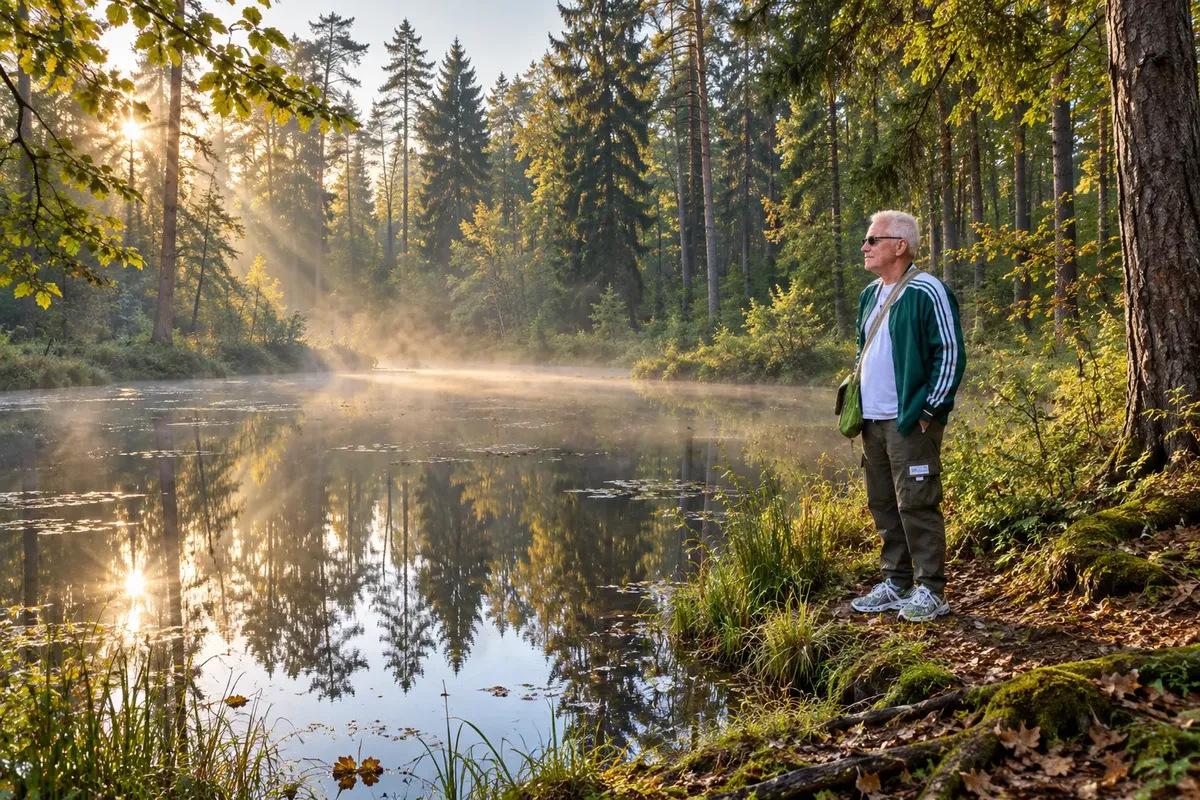
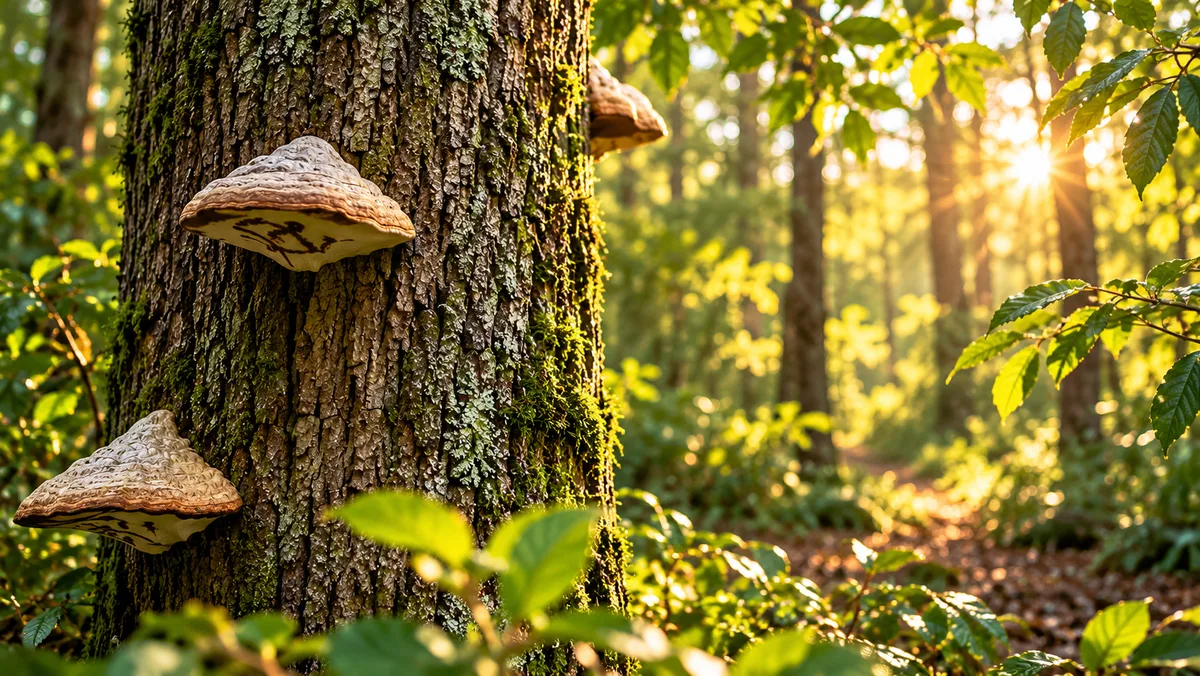
Then we enter the forest, and suddenly things slow down. We feel the ground beneath our feet again. Wind moves the leaves. Birds become audible. Light falls through the canopy. A mushroom stands beside the path that we would not have noticed five minutes earlier.
The world has not changed. Our attention has changed.
Alice and the question: “Who are you?”
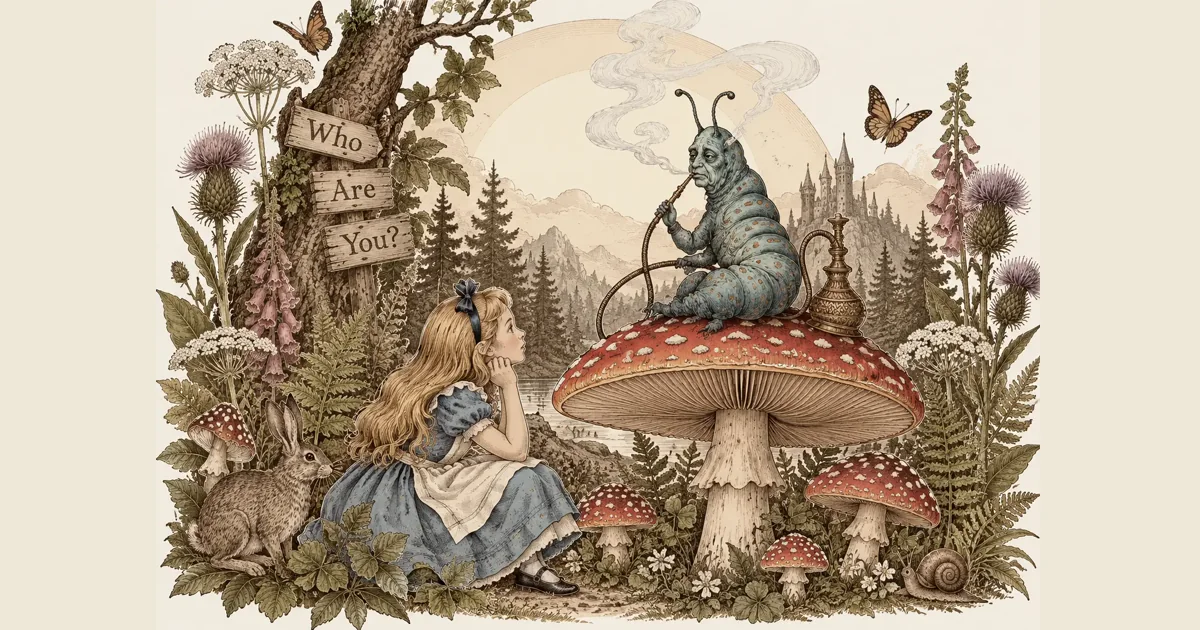
In Alice in Wonderland, Alice meets the smoking caterpillar on a mushroom. The caterpillar asks a seemingly simple yet radical question:
“Who are you?”
Soon afterwards, the mushroom triggers Alice’s changes in size. She becomes smaller and larger, loses her usual bearings and travels deeper into a world where familiar rules no longer work.
The ARTE documentary takes up this connection and interprets Alice’s journey as an image of a shift in consciousness: the outside world remains, but Alice sees it with different eyes.
This should not become a historical claim that Lewis Carroll was describing a psychoactive experience. The link between Alice, the mushroom and altered perception is primarily a cultural and symbolic reading. Yet it works remarkably well as a metaphor. A walk in the forest can also change something – not necessarily the forest, but the way we see it.
The forest as a counterworld to digital life
The documentary presents fly agaric not only as a cultural symbol, but above all as part of a highly complex ecosystem.
The visible red cap is only a small part of the organism. Most of the fungus lives as mycelium in the soil, connected with trees and other organisms. Research reveals how complex these relationships are – and how much we still do not understand.
For me, this is an important perspective: the forest is not a collection of scenery. It is a living network.
We walk through it and see trees, moss, fungi, grasses and animals. At the same time, processes we barely notice are unfolding beneath our feet.
Perhaps that experience is particularly valuable today. We do not always have to explain everything. We can simply observe, perceive and wonder.
Nature connection is not an escape from the modern world
I do not understand nature connection as fleeing technology or civilisation. It is not about condemning smartphones or wanting to return to the Stone Age. Technology is part of our lives.
But our nervous systems, our senses and our attention do not need to follow the same digital rhythm all the time. Conscious time in the forest can offer a counterbalance:
- less screen – more landscape
- less information overload – more direct perception
- less functioning – more being
- less speed – more time
This is where forest guidance begins for me.
Forest guidance: out of the head and into the landscape
My forest guidance is not about “fixing” people. I make no promises of healing and it replaces neither medical nor psychotherapeutic treatment.
It is about something else: creating a space where people can step outside their usual routine for a while.
We walk slowly. We notice. We listen. We look more closely. We feel the ground beneath our feet. Perhaps we leave the smartphone in our pocket.
Sometimes we discover things we would otherwise have passed by: a fly agaric, a particular piece of bark, a bird call, or something entirely ordinary. And that can be enough.
The fly agaric does not need to be eaten
This is particularly important to me. Fly agaric is not a harmless edible mushroom. The documentary describes its compounds and the risks of consuming it. Concentrations of active substances can vary greatly, and uncontrolled consumption can cause severe physical and psychological reactions.
For me, its fascination does not lie in consuming it. I find it far more interesting to encounter it in the forest: to look, notice its colour and shape, and wonder why this particular mushroom has inspired stories of luck, magic, transformation and other worlds for centuries.
Then perhaps simply continue walking.
Resilience does not necessarily begin with a big change
We live in a time when a quick solution is offered for almost everything: a method, a tool, an app, a course, a pill, a technique.
Nature works differently. A forest does not grow faster because we are in a hurry. A tree does not wonder whether it was productive enough today. A mushroom has no goals to meet.
Perhaps therein lies an invitation: not always having to change something immediately, but first noticing what is already here.
My forest guidance invites you to interrupt everyday life for a while, gain some distance and return your attention to your immediate surroundings. For some people, this can be a way to experience more calm, recognise their own resources and deal more consciously with everyday demands.
Not as a promise, but as a space for experience.
Perhaps this is the real message of fly agaric
Alice falls down a rabbit hole into a world where everything is suddenly different.
We do not have to fall down a rabbit hole. Nor do we have to eat a mushroom. Sometimes it is enough to walk through the forest and truly look.
Perhaps this is why fly agaric is such a powerful symbol. It reminds us that beneath the seemingly familiar surface lies a world larger, more complex and more mysterious than we notice in everyday life.
And perhaps that is true not only of the forest, but also of ourselves.
From digital routine into the landscape
If screens, appointments and constant availability sometimes leave you feeling disconnected from yourself and from nature, conscious time in the forest can provide a welcome counterbalance.
My sylvotherapy and nature-based forest guidance is not about pressure, self-optimisation or quick solutions. It is about perceiving. Slowing down. Experiencing nature. Coming home to yourself.
And perhaps one day you will meet a small red mushroom dotted with white. Pause for a moment. Look at it. And ask yourself, in the spirit of the caterpillar:
“Who am I when nobody expects anything from me right now?”
ARTE documentary: Fly agaric
By playing the video, you consent to a connection being established with YouTube. Personal data may be transferred to YouTube. No YouTube content is loaded before you consent.
Jefferson Airplane – White Rabbit
By playing the video, you consent to a connection being established with YouTube. Personal data may be transferred to YouTube. No YouTube content is loaded before you consent.
Would you like to experience the forest yourself?
If an article made you curious, feel free to write to me. Together we will find a suitable date.
Get in touch