Nature connection · Awareness · Becoming whole in nature · · 5 min read
The empty chair
A night, an empty chair and the question of who we have forgotten this year.
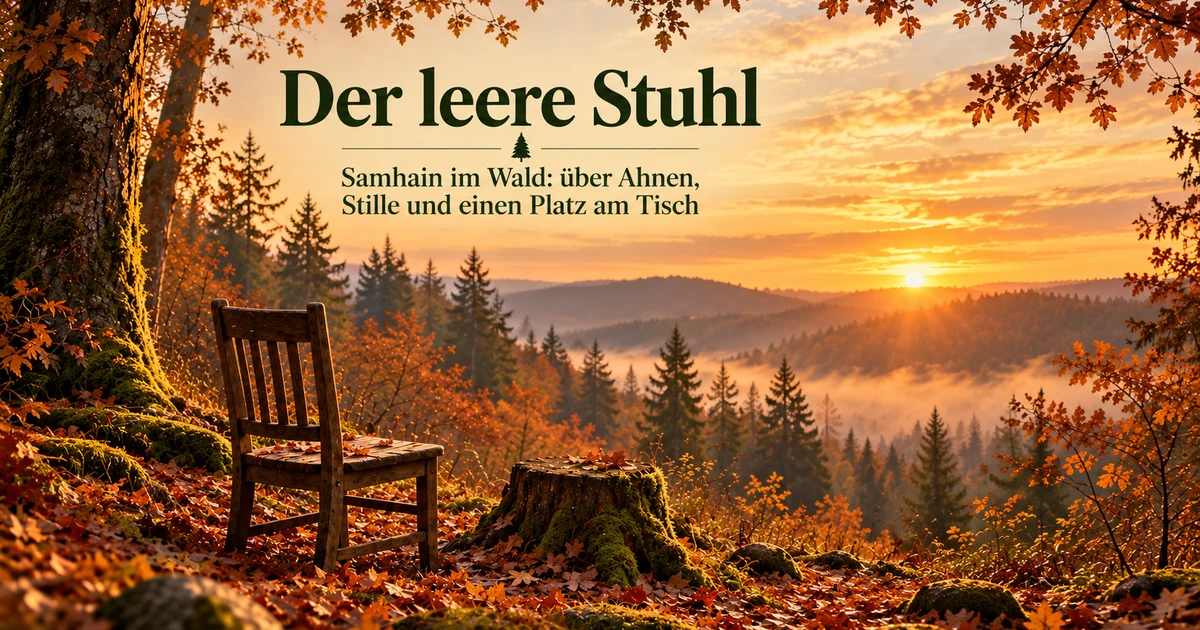
Samhain in the forest: ancestors, silence and a place at the table. On the night of 31 October into 1 November, the forest grows quiet enough to hear what is usually drowned out.
In an Irish poem included in a collected edition in 1907, a family sits by the fire on the night before All Souls’ Day. Outside it is cold. A spirit stands at the door, and nobody notices. The old man has forgotten to put out a chair. By the time he realises, it is too late: “I set no chair to welcome you, my dear.”
An empty chair is a small image that holds quite a lot.
The forest draws inward
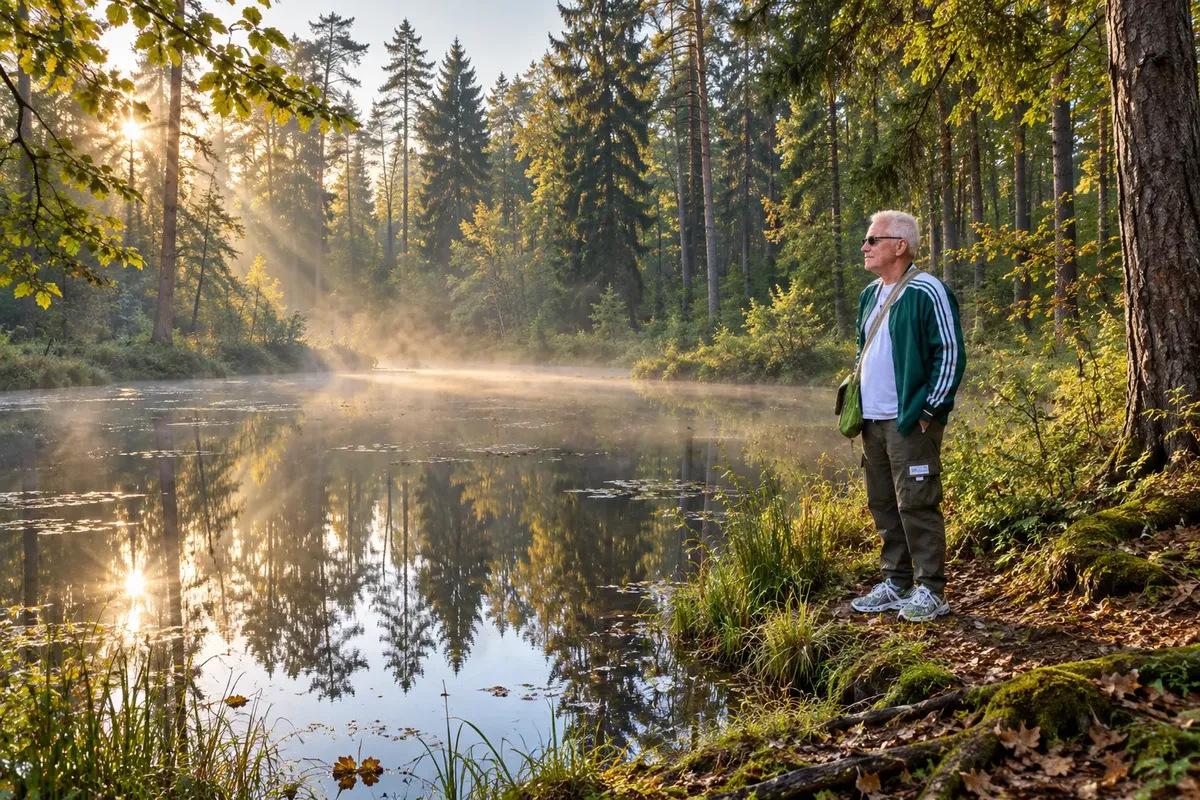
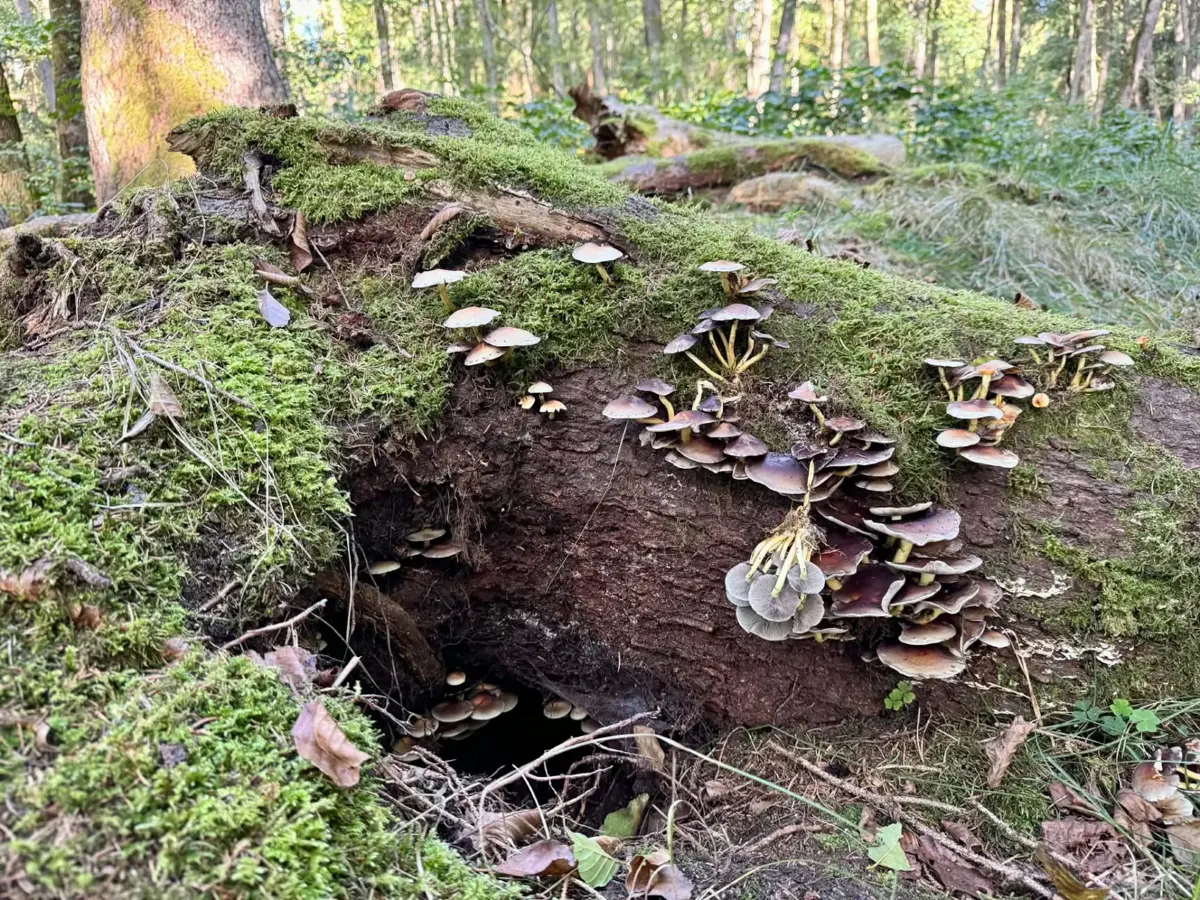
In the forest we can now see what we usually only sense. The trees have shed their leaves and are drawing their strength back into their roots. Underfoot, what was green in spring crackles. It grows quiet, but not empty.
In Irish tradition, Samhain begins the dark half of the year, and the boundary with the Otherworld is considered especially permeable. Whether it was a “Celtic New Year” is disputed among historians. What is certain is that Samhain, All Saints’ Day and All Souls’ Day have become a family of celebrations concerned with the same thing: those who were here before us. Here in Franconia, that means candles in the cemetery, graves covered with tributes, fog. It has little to do with costumes.
The ground beneath us
We stand on what was lived, endured and done before us. On love, but also on hunger, war, guilt and silence around the kitchen table. This is not only true in autumn, but in autumn it is harder to overlook.
When I speak of ancestors at this time of year, I mean both sides. The grandmother who passed on a sense of safety, and the person who suffered or caused terrible things whose consequences still run through families. We can build on both. It is worth looking at what we are building on.
For me this has something to do with horror, though not in the way many celebrate it. I used to enjoy horror films; these days I rarely watch them. Everyday horror and the cruelty in this world are bad enough. I do not need them as entertainment too. For me, Samhain is not about goosebumps, but about looking at what hurts.
What closeness means
What does closeness feel like when someone is there who is no longer here? I cannot prove it. But I know what it feels like when loved ones are gone. My parents have died. My wife, from whom I am divorced, in another way. Gone is gone, and yet the emptiness is different each time.
What helped in such times was rarely a clever sentence. It was a person who simply listens. Who takes my fears, worries and troubles seriously without belittling them or immediately trying to fix them. Or someone who puts their arms around me so that I feel I am not alone.
Often, nothing more is needed. And when I think of those who came before me on this night, I wish the same for them: that someone listens. That someone looks at what they carried and what broke them.
That is the chair.
My trust
I am an optimist. I trust that, in the end, everything will turn out well and make sense, and I believe my soul cannot be destroyed. That is my faith, not an answer to other people’s suffering. It has helped me let go of fear. Someone in the midst of hardship does not need an optimist explaining that everything will be fine. They need someone who puts out the chair.
I hope the cycle of suffering will someday be broken, in my family and beyond. That what has been passed down becomes understood, and what is understood becomes forgiven, and that we are moving towards a unity in which everything is whole. How long that will take, I do not know. I only know it has to begin somewhere, and a night that grows quiet is not a bad beginning. Perhaps it begins not with a grand gesture, but with one person staying with another, taking them seriously and not leaving them alone, even across generations.
Four practices for the forest, a stone or the kitchen table
Listen. Sit silently on a fallen trunk or a stone. Close your eyes. Listen to the wind, the rustling, the dusk. Nothing more.
Gather. Take a few small signs of autumn from the forest floor: a cone, a twig, a stone. In nature reserves, leave everything where it is. At home, give them a place.
Keep a place free. Put a stone on a tree stump or set a chair at the table at home. Ask quietly: Who have I forgotten this year? And who would I rather not have at the table? Imagine listening to the person sitting there. What would they tell you? You do not have to answer anything.
Let go. Take a dry leaf for something you want to bring to a close and place it on the earth or bury it. Open fires in German forests are prohibited, and there is no need for one.
The chair stays
I do not know who will come tonight, and I do not have to know. But I put out the chair, for those whose presence is easy and those whose presence is hard. There is enough room.
Sources
- Dora Sigerson Shorter, “The One Forgotten”(External link), in The Collected Poems of Dora Sigerson Shorter, 1907. The quoted line appears in the original; the poem is in the public domain.
- Digital Victorian Periodical Poetry Project, University of Victoria(External link): earlier publication in Blackwood’s Edinburgh Magazine, September 1898. The chair is an image from the poem; it is not presented here as evidence of a general historical custom.
- Ronald Hutton, “Samhain”, *The Stations of the Sun*(External link), Oxford University Press: Samhain as the opening of winter in early medieval Ireland.
- Ronald Hutton, “The Celtic New Year and the Feast of the Dead”(External link), Folklore 135, no. 1, 2024: the debated interpretation as a “Celtic New Year”.
To listen: “Of Welt Am Draht” (Moritz Von Oswald The One version) by Pantha Du Prince.
Pantha Du Prince – Of Welt Am Draht (Moritz Von Oswald The One version)
By playing the video, you consent to a connection being established with YouTube. Personal data may be transferred to YouTube. No YouTube content is loaded before you consent.
Would you like to experience the forest yourself?
If an article made you curious, feel free to write to me. Together we will find a suitable date.
Get in touch