Awareness · Sylvotherapy · Nature connection · · 7 min read
The tinder fungus doesn’t need a message
Recently, I stumbled across two texts about the tinder fungus. In them, it was the guardian of the forest, the fungus of fire, the healer of the soul, and the teacher of transformation, all at once. As I read, I realised: the more solemn it sounded, the less it had to do with the fungus I know from the forest.
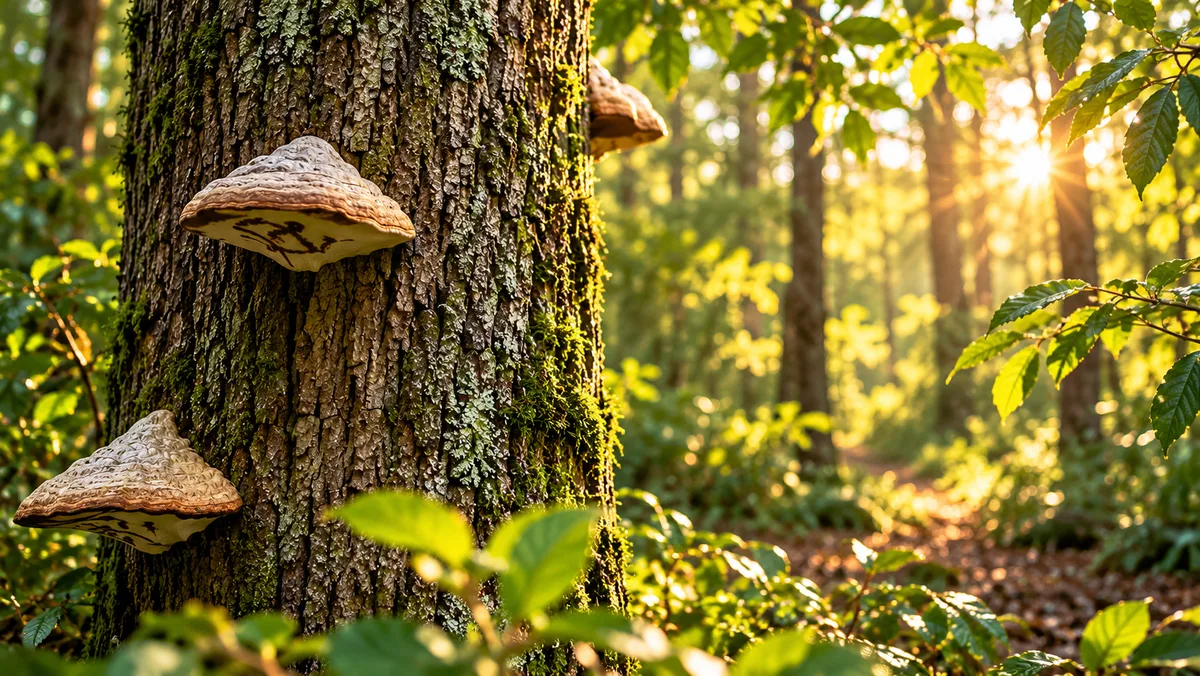
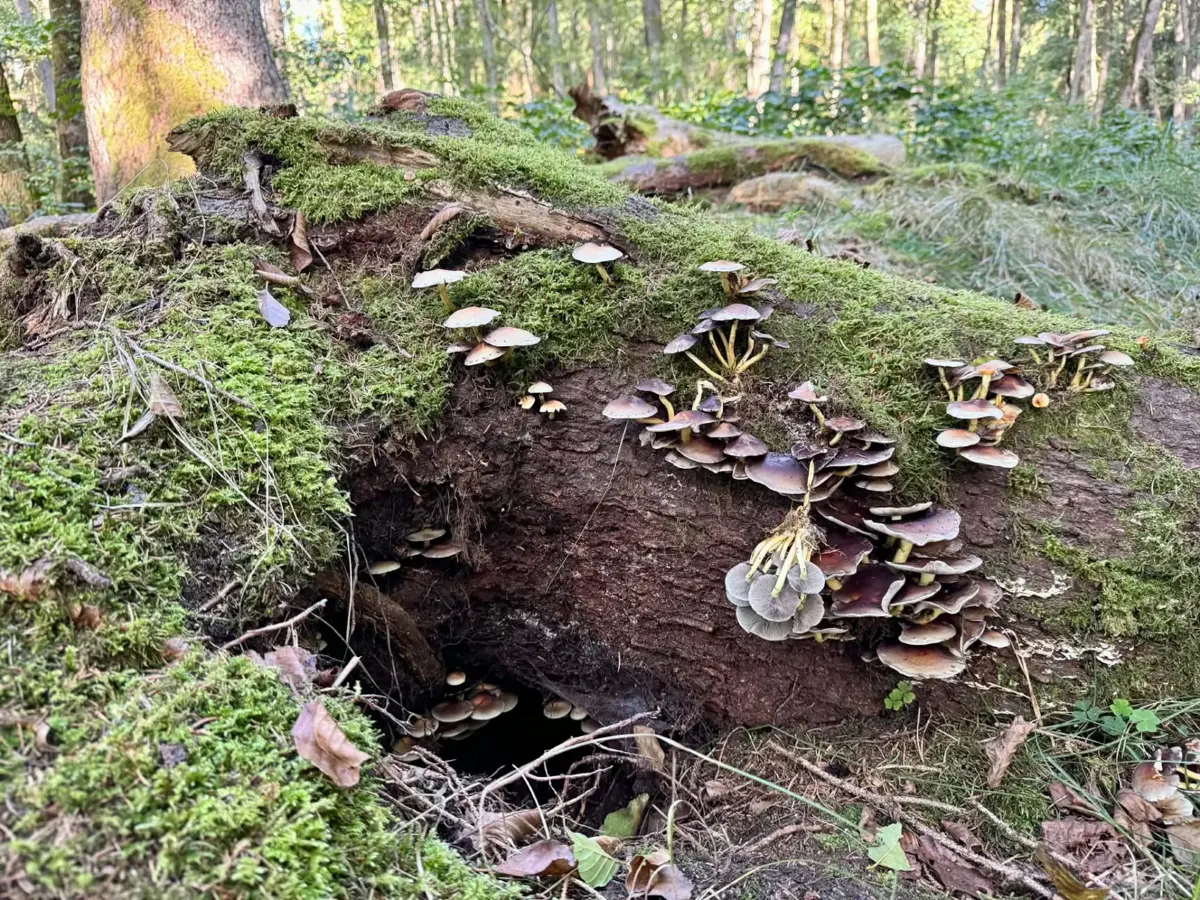
As a child, I often went mushroom hunting in the Reichswald with my grandparents and parents. With every find, there was exactly one question: can you eat it? For the tinder fungus, the answer is no. It’s not poisonous, but it’s as tough as a shoe sole and bitter. Not much use for the basket, then. Only much later did I understand that this grey horseshoe on the tree holds one of humanity’s oldest stories.
Who it really is
The tinder fungus, Fomes fomentarius, is no guardian. It is a parasite of weakened trees. It enters branches and trunks through wounds, in our region primarily in European beeches, but also in birches and poplars. In the heartwood, it breaks down lignin; foresters call this white rot. Eventually, the tree breaks, often several metres above the ground. Once the tree is dead, the fungus simply keeps eating, now as a decomposer.
This is not a symbiosis, as one of the texts claims. In a symbiosis, both partners benefit. But it is not bad luck for the beech either – more of a transformation. The tinder fungus is something like the forest’s undertaker, with an attached recycling centre. It sometimes knocks a little early, but it makes sure nothing of the tree goes to waste.
It is not the guardian of the tree. It is its undertaker. And that is exactly why the forest needs it.
Out of the rotting wood, a dwelling grows. Norwegian researchers found 35 beetle species in the fruiting bodies alone, among them the tinder fungus beetle, which lives practically only in this fungus. Woodpeckers carve holes into the soft wood, and in the end the trunk becomes forest soil. That is the cycle the spiritual texts love to invoke. It only works without a soft-focus filter.
And the claim of indestructibility is only half true, too. A bracket can live for up to 30 years, adding layer upon layer, often twice a year. That is why its age cannot be counted in rings like a tree's. But destroyable it very much is: its guests eat it away from the inside.
Fire since the Stone Age
It has earned its name honestly. Between the hard crust and the tubes lies a felt-like layer, the trama. Soaked, boiled, pounded soft and dried, it becomes a fawn-brown cloth that smoulders at the first spark. Treated with saltpetre or, less appetisingly, with urine and wood ash, it smoulders even better.
Over 5000 years ago, Ötzi carried a piece in his belt pouch, along with traces of pyrite – his fire-lighting kit. Finds from Stone Age settlements go back thousands of years further. Even in the 19th century, demand was so great that fungi had to be imported. In Neustadt am Rennsteig, a staggering 21,5 tonnes were processed in 1842.
There were also waistcoats and caps made from fungus leather, a craft that only a few families in Romania still practise today. And in the Bavarian Forest, children chased knocked-off brackets across fields as if they were balls. The game was called “Huadersautreiben”.
I read nothing of worship in these sources. People used it, collected it, traded it and repurposed it as a football. I think that honours it more than any incense-laden text ever could.
What I won’t sign off on
There are a few claims in those texts that I don’t want to leave unchallenged, because they strike me as too convenient.
The medicinal mushroom. Partly true, historically speaking. Hippocrates described a fungus for wound care, and until the 19th century, pharmacies sold tinder as “Fungus chirurgorum”, a dressing to stop bleeding. It was bandaging material and worked mainly mechanically. For claims such as “strengthens the immune system” and “anti-inflammatory”, there are laboratory experiments and studies of its constituents, including beta-glucans. I know of no robust human studies. Anyone making tea from it does so at their own risk.
Incidentally, Ötzi also carried two pieces of birch polypore on leather straps. Those pieces have been interpreted as possible medicine. The tinder fungus in his pouch was for fire. In many texts, the two fungi merge into one miracle fungus.
Healer of the soul. Here comes a leap I often see in spiritual texts. A substance might somehow affect the body, so the fungus also heals the soul. That’s not logic; it’s a rhyme. I accompany people in the forest and promise no healing. I wouldn’t let a fungus get away with that either.
Burning it for protection and grounding. Smouldering tinder gives off smoke and smells earthy; that’s true. Whether it protects or grounds you is a meaning everyone can choose for themselves. Smoke in your lungs is still smoke.
Hard yet flexible. One of the texts wants both: the indestructible rock in the surf and the one that yields gracefully to the flow. A symbol that means everything ends up meaning nothing at all.
I can understand why texts like these arise. A fungus that brings fire practically cries out for metaphors. But nature becomes a prop in the process. The real fungus disappears behind what we project onto it.
What it shows me anyway
It doesn’t need meanings assigned to it, but it could use some attention. I’ve practised Buddhist mindfulness since I was 18, and in many years of shamanic practice I’ve learned to greet the forest before asking anything of it. With the tinder fungus, both come down to the same thing: looking at what it does and appreciating it.
Take the tinder. A spark alone doesn’t make a fire. It needs something that has been prepared: boiled, pounded, dried. I know that from the meditation cushion. Insight rarely arrives to order. And when it does arrive, it only catches fire where there has already been long, unspectacular practice.
Or the beech. When it dies, that’s not an accident in the system. It is the system. The fungus takes what the tree has built up over decades from light, water and air, and passes it on: to the beetles, to the woodpecker, to the soil from which the next beech grows. The Vietnamese Zen teacher Thich Nhat Hanh had a beautiful word for this: interbeing. Nothing exists on its own. The beech is in the tinder fungus, the tinder fungus in the beetle, the beetle in the woodpecker. And I’m in there somewhere too, at the latest with every breath of forest air.
Everything has its place in the forest. Even the fungus that fells trees.
A small exercise for your next forest walk
Find a beech with tinder fungus. In autumn and winter, you can see the grey brackets from a distance. Stand in front of it for a few minutes and don’t ask what it wants to tell you. Simply look at what is there: the banding of the crust, the small boreholes, perhaps a beetle, perhaps woodpecker traces on the trunk. Put your hand on the bracket if you like. It’s cooler and harder than you might think.
Then think for a moment about everything connected to this one trunk. The light of many summers. The beetles growing up here. The soil beneath your feet, part of which was once a tree just like this.
If you feel like it, say thank you. Aloud or quietly, to the tree, to the fungus, to the whole forest. You don’t need a ritual with rules, just a little willingness. Those who give thanks look differently. And those who look differently don’t simply knock the fungus off. Standing and fallen deadwood with tinder fungus is a habitat. In protected areas, collecting is off limits anyway, and elsewhere a photo is enough.
The tinder fungus doesn’t need a message. It has quietly done its work for millennia so that the old becomes forest again.
Anyone who meets it with open eyes and a little gratitude sees a cycle in which everyone has their place. Us too.
Sources
Wikipedia, “Zunderschwamm” (accessed 14/10/2026), including information on its life cycle, the age of its fruiting bodies, tinder production, Neustadt am Rennsteig, Huadersautreiben, beetle fauna and constituents.
Ursula Peintner, Reinhold Pöder, Thomas Pümpel: “The iceman’s fungi”, Mycological Research 102 (10), 1998, pp. 1153–1162.
For me, Brian Eno’s “Just Another Day” fits here. Another day on which the forest quietly gets on with its work. The linked time-lapse video follows the changing seasons – without imposing a message on the fungus.
Brian Eno – Just Another Day
By playing the video, you consent to a connection being established with YouTube. Personal data may be transferred to YouTube. No YouTube content is loaded before you consent.
Would you like to experience the forest yourself?
If an article made you curious, feel free to write to me. Together we will find a suitable date.
Get in touch