Sylvotherapy · Awareness · · 7 min read
The forest has no money mindset
A coach takes on money mindset and the pressure to be visible. I share much of her anger, reach for a pencil in a few places and wonder what the forest has to say. Nothing. That is exactly what I like.
An angry text about coaches who treat their bank balance as a report card for their soul turned up in my feed recently. I read it twice. The first time I nodded; the second time I needed a pencil.
It was written by a coach who knows the scene from the inside. It is about images familiar to anyone who spends a little time online: champagne on a boat, a test drive in a sports car, a radiant smile. Alongside them comes the message that your bank balance proves how “aligned” you are.
Anyone still struggling, anyone with only four figures in their account, is told they have not resolved their scarcity mindset. Their own fault. The author calls that, pardon the expression, bullshit. I was brought up to be a little more polite. On the substance, I agree with her.
Bassd scho
In Franconia, the highest praise is “Bassd scho”: roughly, “That will do.” Greater enthusiasm is not on offer here. Tell the regulars at the pub you are “living in abundance” and they will ask whether you have eaten too much Schäufele, our local pork shoulder.
I like that sobriety. It offers a little protection against gloss. Once, the Mercedes in the garage was proof of hard work. Now, monthly revenue in a reel is proof of a state of consciousness.
The principle has stayed the same. Only the terms are new.
Light codes have replaced chrome wheels.
The thinking behind it is not new either. Decades ago, psychologist Melvin Lerner described how much people like believing in a just world where everyone gets what they deserve. It is reassuring: nothing can happen to you as long as you do everything right. The other side of it is that anyone poor must have done something wrong. The mindset scene has given this old reasoning error a spiritual explanation. That does not make it kinder.
If you have no money, you now have two problems: an empty account and the blame for it.
Where I nod
For me, the strongest passage is not about the Rolex but about sharing. The author distinguishes between sharing something from the heart once it has ripened and the pressure to turn every pain into content immediately, “before the experience has even had a chance to land within us”. That is perceptive.
There is a term for what lies behind this. In the eighties, psychologist and Buddhist John Welwood spoke of spiritual bypassing: spirituality as a detour around human needs and feelings, avoiding them or skipping over them too soon. The constant high vibes that the text so wonderfully takes apart are exactly that. No doubts, no grieving, or your vibration will drop.
I have practised Buddhist mindfulness since I was eighteen. There are no high vibes on the meditation cushion. You sit with whatever comes, and usually that is the shopping list. Sometimes it is an old sadness.
You do not learn to feel good there. You learn to stay.
Where I need the pencil
A few passages still grate, and I write them down because a text about honesty should be able to bear disagreement.
The author writes that ninety per cent of these coaches are secretly depressed and broke. That cannot be substantiated as stated. Naturally, the people who come to her are those for whom things are not going well. She does not see the others in her practice. If I generalised from the people who come into the forest with me to everyone else, half of Nuremberg would be exhausted. It might be true. I cannot know.
Then there is the “blind society”, whose level of consciousness supposedly reveals itself through alien implants. Here the very trap described in the text snaps shut. Anyone accusing others of placing themselves spiritually above other people should not immediately climb the same ladder. I catch myself doing it too.
It is remarkably comfortable up there.
And the conclusion: freedom is the moment your thoughts stop revolving around money. It is a lovely sentence, and I understand the intention. But someone receiving basic income support who cannot afford an extra electricity bill is not thinking about money because of a wrong attitude.
That is not a scarcity mindset. That is mathematics.
Earlier, the author rightly defends precisely these people against the scene. At the end, she slips a little into its logic herself: a problem in the bank account becomes a question of inner attitude.
And my own part in it
Before I go too far: I sell something too. Time in the forest, companionship, perhaps more before long. My marketing plan includes reels, several a week if the plan has its way. With my face, in the forest, in thirty seconds. So I am not the man at the forest edge watching everyone else perform.
I have given myself two rules. First, I say that you do not actually need anyone to go into the forest. You can simply set off. Second, I promise neither healing nor abundance nor transformation, at most a moment in which your head becomes clearer. Whether that is enough to keep me out of the same role is for others to judge.
A reel nobody watches changes nothing about the forest. Hopefully nothing about me either.
Stay down for a while
For me, the strongest image in the text is a sentence against those slogans about pushing through: “Just stay down for a while.” Not straighten your crown and carry on, but stay below and look closely.
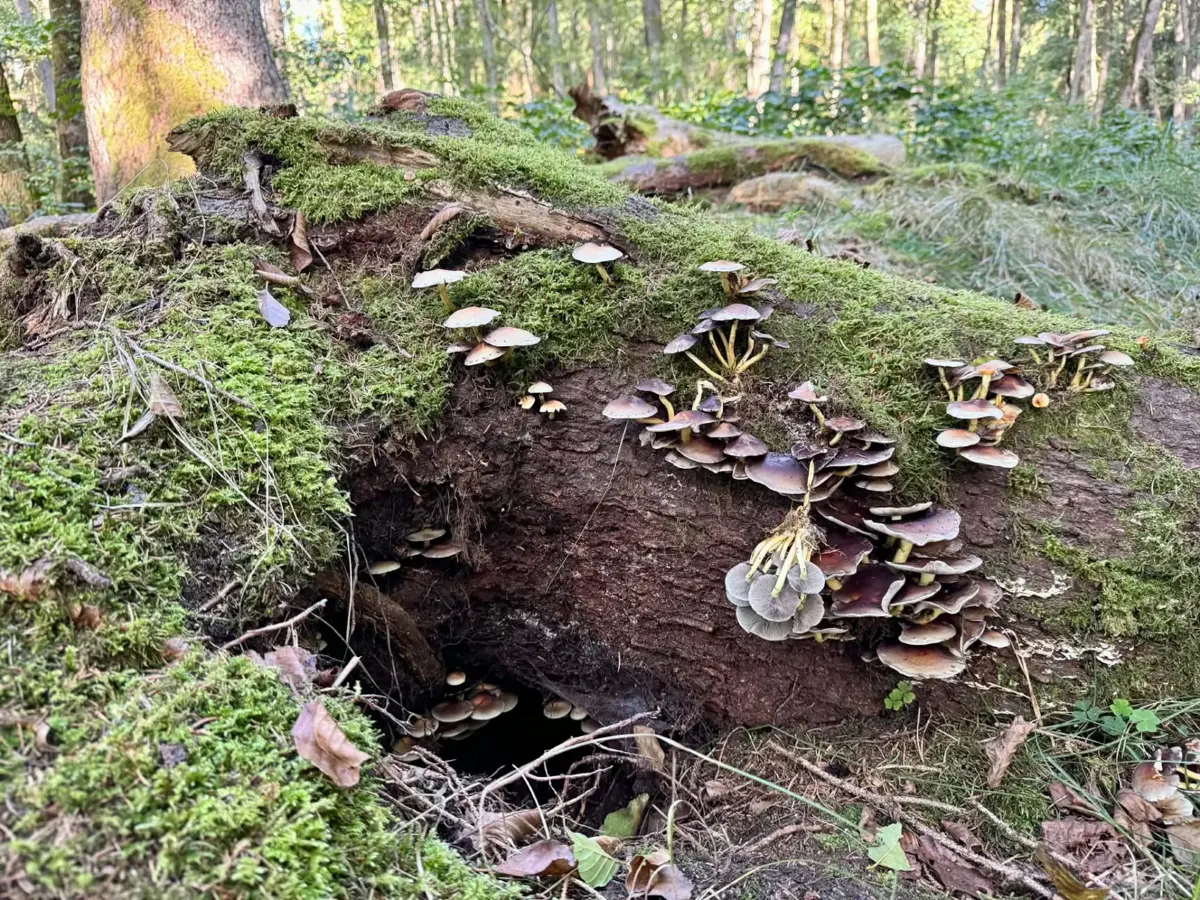
In October, the forest is demonstrating that very thing. The beeches shed their leaves without planning a launch first. And a fallen trunk is anything but a failure. Deadwood is habitat. Fungi, lichens, beetles and woodpeckers live on it; many rare species specialise in it. A fallen tree is one of the forest’s most popular places.
A qualification belongs here, because I can read the sentence another way too: staying down means for a while, and not alone. Anyone who notices they cannot get up at all needs more than a walk. The forest does not replace therapy, even if my website is called Sylviotherapie.
What the forest measures
The forest measures nothing. No bank balance, no reach, no vibration level. The beech I stand beneath does not know whether I am employed, self-employed, selling bread in a bakery or retired. It could not care less. That is not indifference. It is the kindest form of equal treatment I know.
The author quotes Jim Carrey on this, and the quote is real. In 2005, he told the Ottawa Citizen: “I think everybody should get rich and famous and everything they ever dreamed of so they can see that that’s not the answer.” That is said by someone who had both and still spoke openly about his depression. I am glad I do not need the detour via Hollywood. An afternoon in the Reichswald is considerably cheaper.
On this point, the author is entirely right: no number can tell you a human being’s worth. In the forest, you do not have to believe it. You can try it for two hours. Nobody wants anything from you there, and after a while you notice you have nothing to prove either.
For an afternoon in the forest, the Franconian maximum of abundance is enough for me:
Bassdscho.
Sources
- Melvin J. Lerner, The Belief in a Just World: A Fundamental Delusion, Plenum Press, 1980.
- John Welwood, Toward a Psychology of Awakening, Shambhala, 2000 (the term “spiritual bypassing” dates from 1984).
- Burkhard Herzig, Der Baum ist tot, es lebe der Wald, Wald und Holz NRW, waldwissen.net, 2017.
- Jim Carrey in conversation with Jay Stone, The Ottawa Citizen, 16 December 2005 (documented by Quote Investigator).
That brings Janis's song to mind:
Joplin recorded the song on 1 October 1970 in a single take, a cappella, with only her voice and a foot tapping the beat. Three days later, she was dead. It is the opposite of gloss: one voice, no glitter, nothing staged. As with Jim Carrey, here is someone who had fame and knew it was not enough.
There is another historical irony: Mercedes later used the song in advertising. Michael McClure, whose poem the lyrics draw on, said he did not want to watch the commercial. The criticism of bling had itself become bling.
Janis Joplin – Mercedes Benz (Official Audio)
By playing the video, you consent to a connection being established with YouTube. Personal data may be transferred to YouTube. No YouTube content is loaded before you consent.
Would you like to experience the forest yourself?
If an article made you curious, feel free to write to me. Together we will find a suitable date.
Get in touch