Awareness · Nature connection · · 7 min read
Komorebi – A mushroom in the spotlight
A word German doesn't have, a bay bolete in the spotlight and the question of what happens when you're not looking.
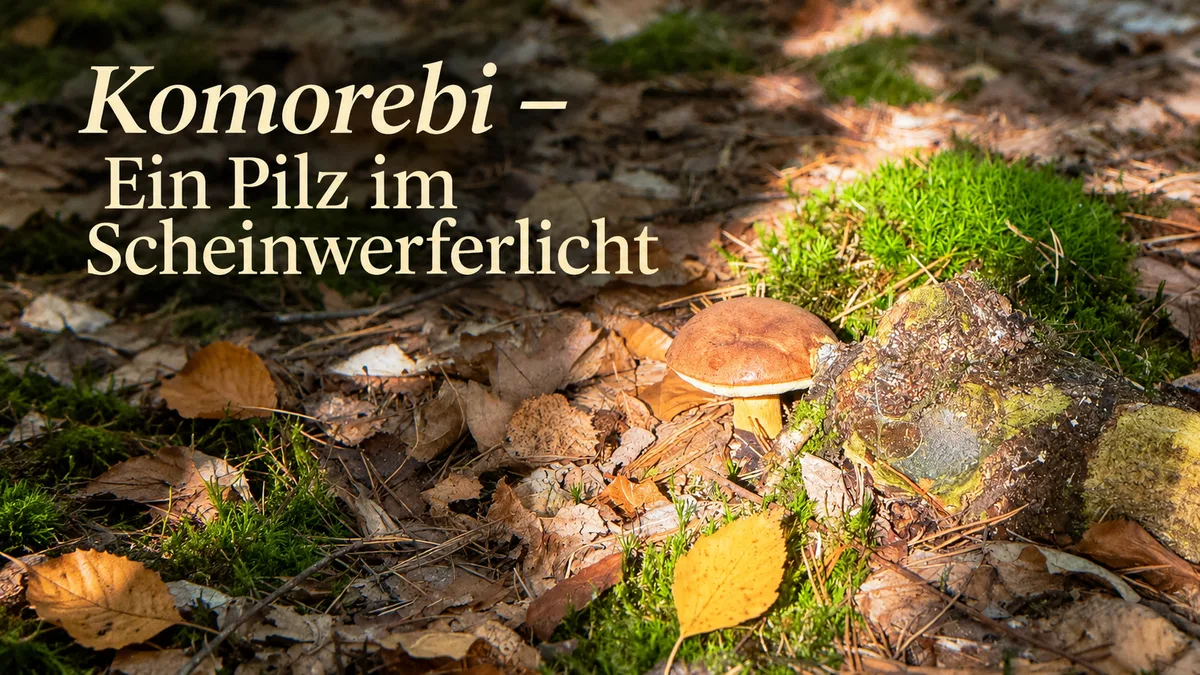
The Japanese have a word for light falling through leaves. In the Reichswald forest I got a bay bolete with it, one that simply refused to be overlooked.
On 4 October I was out in the Reichswald at around four in the afternoon. The sun was already low, sending its light slanting between the trunks. I had a knife and a jute bag with me, like everyone who heads into the Reichswald in autumn. I wasn't looking for anything. Honestly, though, mushrooms were at the back of my mind, the way you never want nothing at all in a bakery.
Then a ray of sunlight fell on the forest floor, and not just anywhere. It hit a bay bolete. It stood there as if a lighting technician had set it up: fresh, firm, a picture-book mushroom and rather cheeky. Half-shade all around, and in the middle this thing that looked like a neon sign reading "Here I am, for you."
I took a photo, got out the knife and cut it. No searching, no kneeling in the leaves, no plan. The first mushroom of the day, and it did the work for me.
By the way, the light in the photo looks tamer than in my memory. Memories like to exaggerate; the photo is the more honest witness. That the mushroom sat in the light is beyond dispute all the same.
A word we don't have
In Japanese, what happened there is called komorebi (木漏れ日). Three characters: tree, seep through, sun. The light seeps through the trees like water through a sieve.
You often read that the word is untranslatable. That's only half true. It can be translated: sunlight falling through leaves. We just lack the single word for it. In English, "dappled sunlight" comes closest, but the leaves are missing. In German we make do with paraphrases.
Looking it up, I found a few more details. Komorebi is not a seasonal word of the kind common in haiku; the light exists in every season. Poets sometimes write it with an old-fashioned character that has dropped off the school list. And there is a relative, hamorebi, for light falling through foliage rather than branches. For moonlight through branches there is no word.
A patch of light wanders as soon as a leaf moves or the sun moves on. It never comes back quite the same.
Why the patches are round
Now comes the part I find most beautiful. Every small gap in the leaves works like a pinhole camera. It casts an inverted image of the sun onto the ground. That's why the patches are round even when the gap is angular. They are lots of little suns.
During a partial solar eclipse they turn into crescents, because the sun itself has a bite taken out of it. You can see this under any tree. Once you've seen it, you'll never look at a treetop the same way again. (Looking directly at the sun doesn't count, of course.)
For what I saw in the Reichswald, I don't need the word "magical". The mushroom stood in an image of the sun. That's enough for me.
Who the light belongs to
For us, a patch like that is atmosphere. For the plants on the forest floor it is food. Forest studies find that in the understorey more than 80 percent of the photons reaching the leaves come from such brief sunflecks. Each one lasts seconds to minutes.
My bay bolete, on the other hand, got nothing out of it. Fungi don't photosynthesise; they don't need light. So the spotlight wasn't meant for it.
The mushroom gets nothing from the spotlight. The spotlight was for me.
And even that is only half true. If you carry a knife and a bag, you see the mushroom. Had I been out with a camera, I might have seen the bark in backlight instead. The light didn't pick the mushroom for me. It just didn't hide it.
What research says, and what it doesn't
Whether sunflecks affect us humans is not well studied. I found one small study: 45 people, at a screen, with dappled-light patterns as a background. The patterns were liked more than an even grey image and seemed more fascinating and more natural. Measurable recovery from stress did not show up.
For forest bathing as a whole there is a 2023 review: after time in the forest, blood pressure was on average a good three points lower, and the stress hormone cortisol in saliva somewhat lower. But the studies differ greatly, and you can't blind a walk in the woods. None of this has anything to do with komorebi; what was measured was the forest as a whole.
So I can't tell you that a patch of light heals anything. That it pleases, yes.
My knife and the cook
Recently I watched a video about the Chinese philosopher Zhuangzi, who lived in the 4th century BC. It features a cook carving an ox for a prince. He doesn't cut through; he follows the natural joints. His knife, he says, has been as sharp as freshly honed for 19 years.
Behind this lies the idea of wu wei, often translated as "action without action". It isn't doing nothing. It means acting in a way that doesn't come from willpower and calculation. The cook practised for years to get there.
My mushroom harvest was similar, only smaller. It was effortless because I have been walking through the Reichswald since childhood and know what a bay bolete looks like.
Effortless is what has long been practised.
My knife, incidentally, is much younger and only worked briefly for this one mushroom.
Hirayama and the trees
Wim Wenders' film Perfect Days (2023) tells the story of Hirayama, who cleans public toilets in Tokyo. His daily life is strictly ordered. He listens to cassettes, reads books and almost every day photographs the light in the treetops with an analogue camera. The word komorebi isn't spoken once in the whole film. It only appears in the end credits. The images return in black-and-white dream sequences.
Kōji Yakusho won Best Actor at Cannes for the role. I think that's partly because he doesn't try to do anything special. He looks up. To his niece he says a line worth remembering: "Next time is next time, now is now."
In Japan, komorebi is often placed alongside two other concepts: mono no aware, the quiet wistfulness about the passing of things, and ichi-go ichi-e, "one time, one meeting", from the tea ceremony. The dictionary doesn't list these under komorebi; that's my reading. Still, a patch of light fits for me: it's there, and then it's gone.
A minute for your next walk
Find a patch of light on the ground and watch it wander for a minute. Don't hold on to anything, not even with your phone.
Hold your hand in it. The image of the sun lands on your skin, and if you cross your fingers, you build your own pinhole camera.
And if a photo comes to mind afterwards: go ahead. I'm no role model there.
My bay bolete now hangs sliced and dried in my kitchen, giving mushroom dishes a light taste of the forest. That's the whole message. I promise no healing. But a neon sign like that runs somewhere in the forest every day. Mostly nobody looks.
To listen
Two pieces of music accompany me on this theme. The first is "Komorebi" by Duke Boara, a good ten-minute piece to sink into. The second is connected to the film: "Perfect Day" by Lou Reed from 1972, which features in Wenders' film. I won't reproduce the lyrics; listen for yourself. If you only listen to one, make it this one.
Sources
- Tokyo Weekender: Japanese Words We Can't Translate – Komorebi (Lisandra Moor, 2020, 2024)(External link)
- Chicago Botanic Garden: Komorebi(External link)
- University of Richmond, Physics blog: Pinholes and eclipses(External link)
- Wikipedia: Sunfleck (Chazdon & Pearcy 1991; Pearcy & Way 2012)(External link: Wikipedia)
- Chamilothori et al. 2022, TU Eindhoven: Effects of dappled light patterns on preference, fascination and restoration(External link)
- Qiu et al. 2023: The Effects of Forest Therapy on the Blood Pressure and Salivary Cortisol Levels of Urban Residents, IJERPH 20(1)(External link)
- Wikipedia: Perfect Days(External link: Wikipedia)
- Stephan Koplowitz: „Perfect Days“ – Wenders' cinematic diary of dappled light & shadow, arts•meme, 08/01/2024(External link)
- Experiencing Komorebi Through Wenders' Perfect Days, UMSU(External link)
- Wikipedia: Mono no aware(External link: Wikipedia)
- Wikipedia: Ichi-go ichi-e(External link: Wikipedia)
- Duke Boara – Komorebi (YouTube)(External link)
To listen: "Komorebi" by Duke Boara, a good ten-minute piece to sink into.
Duke Boara – Komorebi
By playing the video, you consent to a connection being established with YouTube. Personal data may be transferred to YouTube. No YouTube content is loaded before you consent.
To watch: the official trailer for “Perfect Days” by Wim Wenders, in which “Perfect Day” by Lou Reed plays again and again.
"Perfect Days" – Official Trailer
By playing the video, you consent to a connection being established with YouTube. Personal data may be transferred to YouTube. No YouTube content is loaded before you consent.
Would you like to experience the forest yourself?
If an article made you curious, feel free to write to me. Together we will find a suitable date.
Get in touch