Nature connection · History · Awareness · · 11 min read
Stillness in the city park – Autumn, All Saints’ Day and Pepe
Autumn gold, difficult history, an ancient lime tree and a curious squirrel: an All Saints’ Day walk through Nuremberg’s city park.
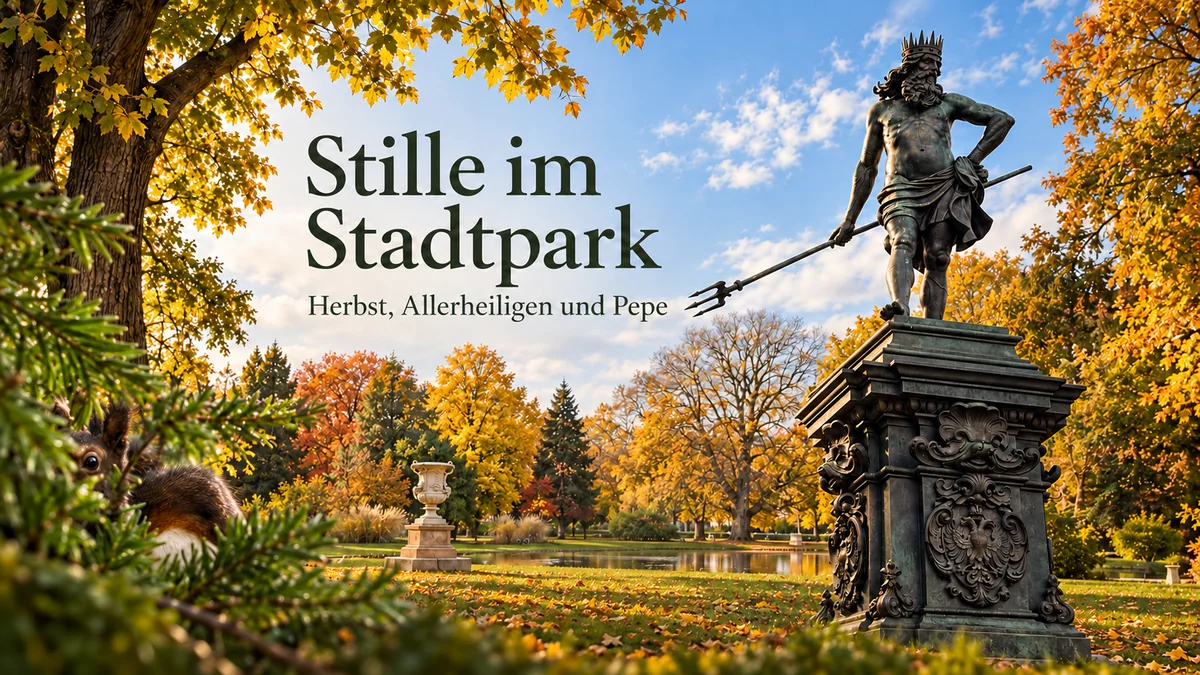
All Saints’ Day, Sunday, the city park: fallen leaves, stillness, a bronze sea god, probably the oldest tree in the city, and a black squirrel who would rather take another look than disappear.
Gold on the grass
Autumn doesn’t begin with a bang in the city park. It creeps in. First a yellow leaf on the asphalt path, then a whole tree that looks as though someone has switched on a light behind it.
By early November, it’s at its peak. Gold still hangs in the treetops, fallen leaves already carpet the grass, and somewhere in between, a lone shrub burns red like a traffic light nobody pays attention to.
Some mornings, fog swallows half of it. The pond disappears, the trees become pencil sketches, and you can hear your own footsteps. And when the sun does fight its way through, that deep, soft light arrives, treating tree trunks, leaves and pushchairs alike.
I went there to look closely. Beauty is the first thing you see. But the park has more to tell if you let it, and not all of it is golden.
All Saints’ Day: stillness by law
Today is 1 November, and in Bavaria that’s a public holiday with the handbrake on. All Saints’ Day is one of the “quiet days”. According to the City of Munich’s information page(External link), the dance floor stays empty from 2 a.m. to midnight, events that don’t suit the solemn character of the day are prohibited, and anyone breaking the rules risks a fine of up to €10.000. In 2026, the day also falls on a Sunday. Doubly quiet, at least on paper.
That brings me up against a question: what kind of stillness has to be ordered? A law can empty the dance floor. It doesn’t empty your head. Anyone who stares at their phone for hours on a quiet public holiday has obeyed the ban without spending even a minute hearing nothing.
Yet there’s something good at the heart of the day. All Saints’ Day is when people visit graves and pause, for their dead and, to some extent, for themselves. That doesn’t need a regulation. It needs five minutes and a reason.
And in the park? It never becomes completely quiet there. Somewhere a child calls out, a dog settles questions of ownership, and the city hums beneath it all like a background layer. Whether things become quiet is decided less between the trees than between your ears.
Green space with history, and the history beneath it
The city promotes its park with the phrase “Green Space with History”. True enough. The question is which history gets told first. The short description mentions folk festivals, political gatherings, two state exhibitions and villa plots that paid for the expansion. The name under which the hill appeared on maps for centuries is missing: Judenbühl.
It does turn up in the city’s background text, and it carries quite a weight. According to the Nuremberg City Encyclopaedia, Jews were burned on this hill during the plague pogroms of 1349, and the rubble from their destroyed homes is said to have been dumped here. Today, the Hauptmarkt and the Frauenkirche stand where the Jewish quarter and synagogue once stood. The city presents this as fact; Wikipedia qualifies it with “is said to”. The earliest map evidence cited by the city is the Pfinzing Atlas of 1594, 245 years after the pogrom.
The pogrom of 1349 is history. That the name comes from precisely that event, and that this exact scene took place at this exact spot, is a matter of inherited accounts. I find them plausible, but I’m writing about them as what they are.
Then a king came to the folk festival. Maximilian II was visiting, the municipal council asked permission to rename Judenbühl as Maxfeld, and the king granted it. A place that recalled a pogrom became a place that honoured a king. My sources don’t establish whether that was intentional. A petition to the sovereign needn’t have had malicious intent. It simply doesn’t change the fact that the park manages without its old name today, and that I found no mention of a memorial to it in the texts available to me.
Where the sources disagree
Reading across the sources, I noticed places where the city’s account and Wikipedia don’t match. I’m only adopting what agrees, and identifying the rest as contradictions:
- Plantings by forestry official Volkamer. City of Nuremberg (background text): Probably from 1747, with further plantings around 1758/59. Wikipedia: Around 1759.
- Renaming as Maxfeld. City of Nuremberg (background text): Folk festival in 1855 with King Maximilian II. Wikipedia: Folk festival on 3 July 1859; the introduction, however, gives 1855.
- Post-war redesign. City of Nuremberg (background text): 1952 to 1954. Wikipedia: A 1958 design under parks director Kurt Ahles.
- Marble vases. City of Nuremberg (background text): Commemorate the singers’ festival of 1861 and the state exhibition of 1882. Wikipedia: The same in the text, but the image caption gives singers’ festivals in 1891 and 1912.
For anyone who needs the precise details: Rudi Viertel’s Vom Judenbühl zum Maxfeld (“From Judenbühl to Maxfeld”; City of Nuremberg, 2nd edition, 2007) appears in Wikipedia’s bibliography and would be the next thing to reach for.
Neptune and his moves
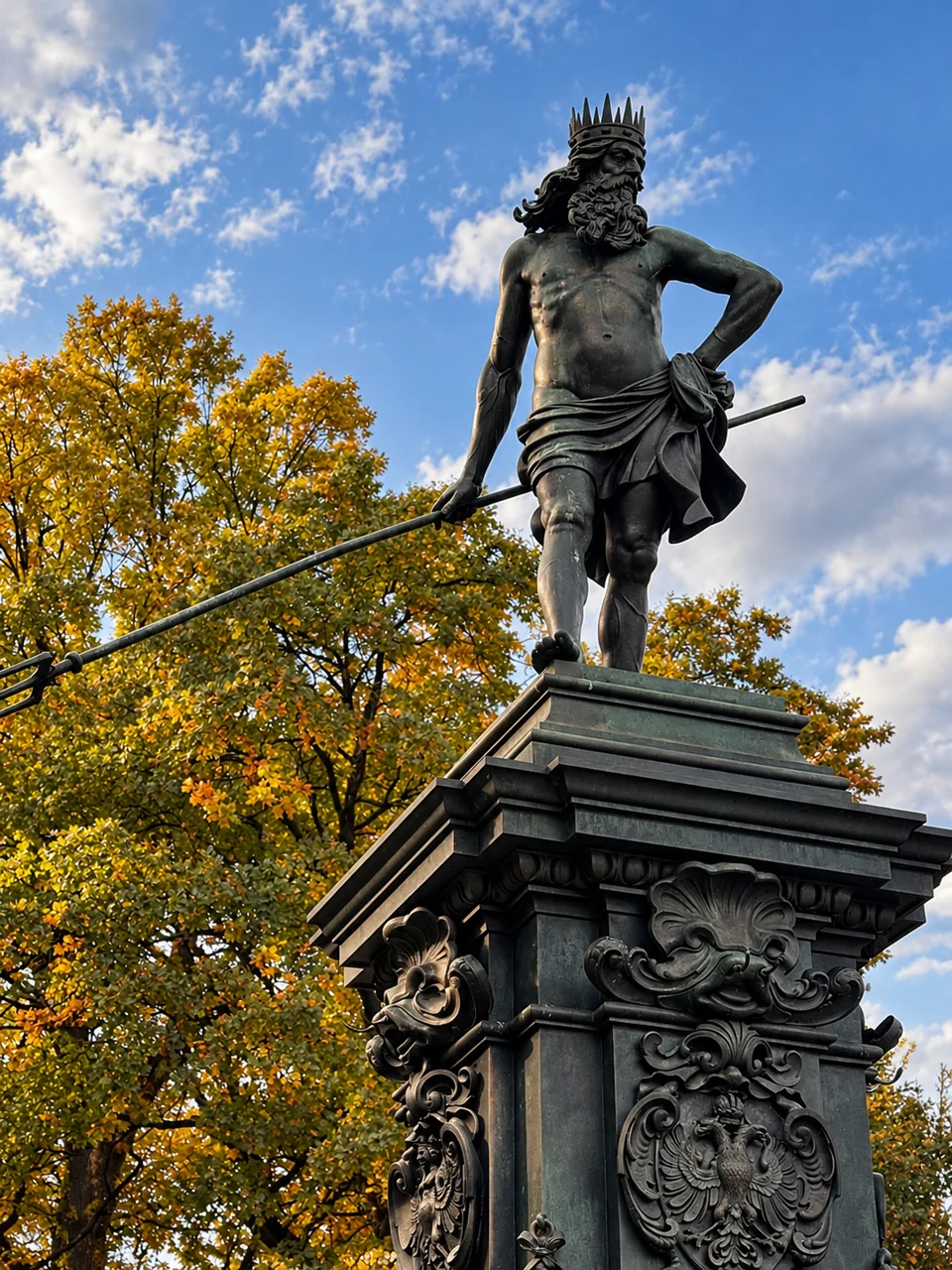
There he stands by the pond, in bronze, with a crown, a trident and one hand on his hip. His gaze passes over everyone, including me. Shells, mythical heads and a coat of arms with a double-headed eagle sit on the base. The man has been around, and not of his own free will. According to Sebastian Heider’s article (2016) and Wikipedia, his journey looks like this:
- 17th century: Georg Schweigger and Christoph Ritter design the fountain for the Hauptmarkt, to replace the Schöner Brunnen. Technical problems prevent this, and the ensemble spends around a hundred years in the municipal works yard.
- 1797: Tsar Paul I buys the fountain and has it shipped to St Petersburg.
- 1896: Plaster moulds are taken in Russia and a second casting is made. This goes on the Hauptmarkt, opposite the Schöner Brunnen.
- Nazi era: The fountain is dismantled—according to Wikipedia, in 1934, because of the Nazi Party rally marches—and stands on Marienplatz, now Willy-Brandt-Platz, from 1937 onwards.
- 1962: It moves to a concrete basin in the city park, where it stands today.
Two things strike me. First: the Neptune in the park is the second edition; the original is in Russia. Being honest means saying that too. Second: Heider speaks of a “brief interlude” on Marienplatz. According to Wikipedia, the fountain stood there from 1937 to 1962. That’s a quarter of a century, not an interlude.
Why it disappeared from the Hauptmarkt is the uncomfortable part. Wikipedia cites the marches. Heider adds that it was “not least” because the donor, Ludwig von Gerngros, a hop merchant and patron, was of Jewish origin. That is a claim; the article provides no evidence for it. So that’s how I’m passing it on: as Heider’s interpretation, not as an established fact.
And since today is All Saints’ Day: Georg Schweigger, Neptune’s creator, is buried in St John’s Cemetery, which also has a few epitaphs by his hand. Anyone visiting the graves anyway has one more reason to go there.
The lime tree that is older than the park
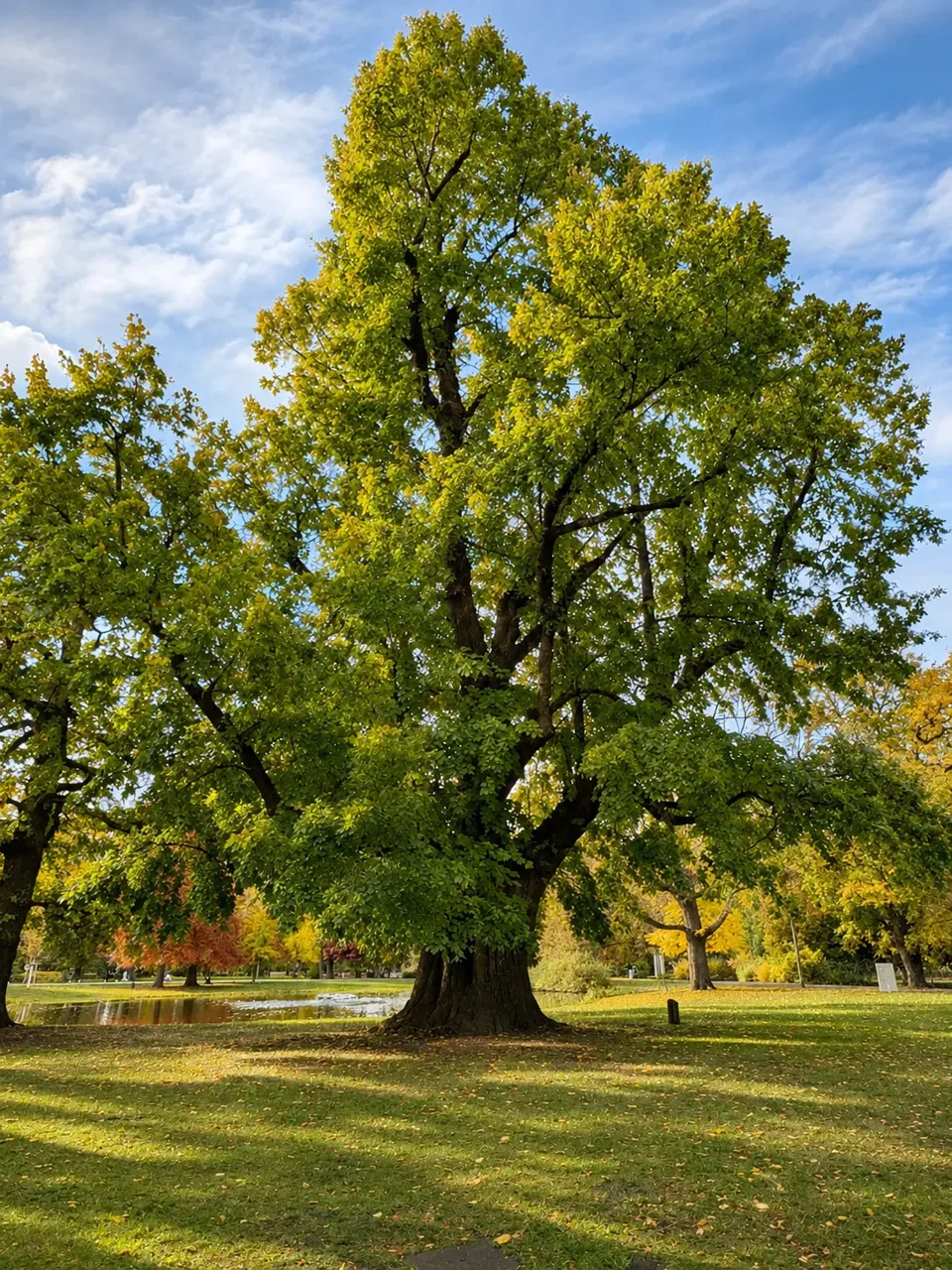
Nuremberg’s oldest tree is said to be a lime tree in the middle of the city park, opposite the Schiller monument. According to nordbayern.de(External link), it is about 400 years old, has a trunk circumference of around eight metres and is a protected natural monument. Visitors reportedly like to place a hand reverently on its bark.
I understand why people do that. Bark is rough, cool and very real, and suddenly your own timescale shrinks: a few decades against four hundred years. The tree has nothing to say about it. That makes it more likeable than everyone who writes about it.
Now for the critical part, because “oldest tree” sounds like a measurement, and it isn’t. The 400 years are an estimate based on historical depictions. A more precise determination of its age would damage the trunk, so they leave it alone. The second-oldest lime tree, at Hallerwiese, is estimated to be “over 350” years old. With two estimates this close together, the ranking is a label, not proof. And I found only this one source for that information.
Nor does it fit neatly into the park’s history. The sources date forestry official Volkamer’s first plantings to between 1747 and 1759. A tree that sprouted around 1626 would therefore have stood on the hill a good 120 years before the first park. The name Judenbühl, on the other hand, already appeared in the Pfinzing Atlas in 1594, a good thirty years before the lime tree would have sprouted. I can’t tell from my texts whether this part of today’s park already belonged to Judenbühl at the time. But if the estimate is right, the lime tree is the oldest witness here. Older than the rows of trees, older than the balloon of 1787, older than the name Maxfeld.
Pepe
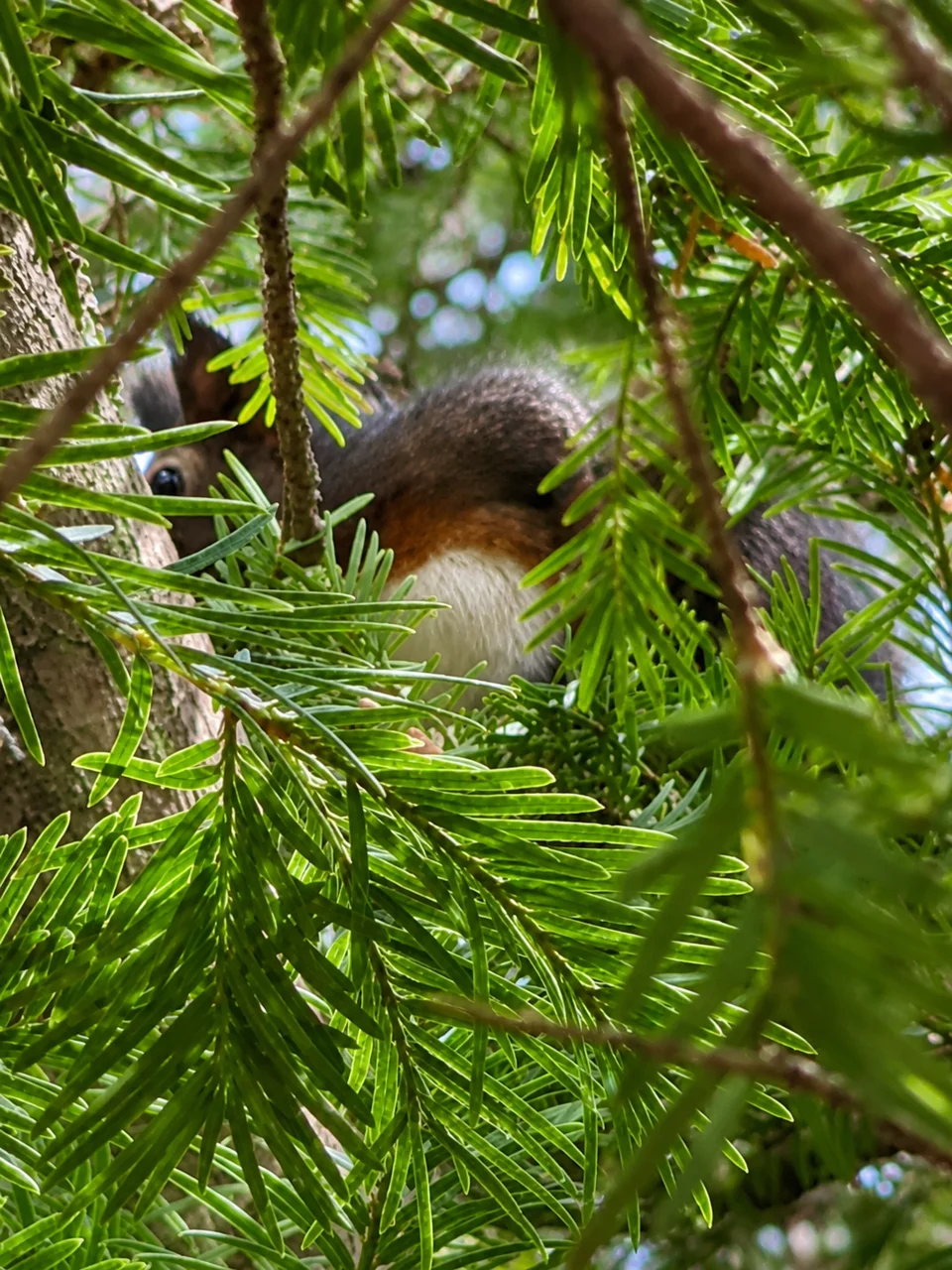
And then there was Pepe. Pepe is called Pepe because that’s what I call him. He himself has never commented on it. He’s black, or almost: a dark-coated variant of the native squirrel, with only his belly white. My favourite squirrel, I admit it.
He ran away. Nothing new there; to a squirrel, I’m a large, clumsy predator with a phone. But he stopped. Turned round. Looked to see what I actually wanted. Ran a little farther, stopped again, looked again. Over and over: run away, look back, run away, look back. I didn’t follow. If you chase after a squirrel, you’ve already lost.
You don’t see much of that in the photo: behind conifer branches, an eye, a patch of white belly; the rest is fur and caution. He really was curious, that one.
The devil’s advocate in me pipes up, of course. The sober reading: park squirrels know people, and some of us carry nuts. He’s probably checking whether I’m one of them. The nicer reading: he wanted to know. I’ll take both. I still like the fact that curiosity overruled fear every single time. Fear and curiosity at once, neither giving way. I know that feeling myself. Run off first, then take another look after all.
A poem to go with it
What really belonged here was an autumn poem by someone from Nuremberg. I haven’t found one that I could verify and quote without questions about rights. Anyone wanting to explore seventeenth-century Nuremberg poetry can start with the Pegnesischer Blumenorden. Until then, a verse of my own will have to do:
All Saints’ Day in the city park
The leaves fall without warning.
The pond holds still.
A god of bronze looks past us,
the old lime tree says nothing.
Only one runs away, stops,
runs away, stops
and wants to know.
What remains
A city park is not a forest. It is constructed nature, transformed into a landscape park by Georg Zacharias Platner in 1856, laid out anew after the war, and repeatedly worked on to this day. That doesn’t make it false. Even the most carefully staged park has autumn, and even there you can practise what comes more easily in a forest: looking closely without immediately passing judgement.
Here, looking closely also means not overlooking what is uncomfortable. The gold is real. So was the name Judenbühl.
One minute for your next walk
- Stop. You don’t have to practise anything.
- Notice what you hear, what you see and how you’re breathing right now.
- Pick something that isn’t beautiful, and look at it anyway.
- Walk on.
And if something looks at you along the way when it ought to be running away: stop too. I’m not promising you anything more than a moment in which your head becomes a little clearer. Pepe doesn’t even promise that.
Sources
Stadtpark Nuremberg, Wikipedia(External link: Wikipedia)
City of Nuremberg: “Background: The Development and History of the City Park” and “Green Space with History”
Sebastian Heider: “Georg Schweigger, or: The Journey of the Neptune Fountain”, 13/06/2016
400 years old and healthy: these are Nuremberg’s oldest trees, nordbayern.de(External link)
Quiet public holidays in Munich, muenchen.de(External link) and Bavarian Public Holidays Act, section 3, gesetze-bayern.de(External link)
To listen: “Autumn” by Hamatsuki.
Hamatsuki – Autumn
By playing the video, you consent to a connection being established with YouTube. Personal data may be transferred to YouTube. No YouTube content is loaded before you consent.
Would you like to experience the forest yourself?
If an article made you curious, feel free to write to me. Together we will find a suitable date.
Get in touch