Sylvotherapy · Nature connection · Awareness · · 8 min read
Who tends also weeds
An essay celebrates care as a way of relating to the world. I share its direction, but ask: who decides what may grow – in the garden, the forest and care itself?
An essay on “tending the becoming” kept me busy for two evenings. I share its direction. A few spots still chafe, though, and those are exactly what I find interesting.
On the site Dialogische Ästhetik im Anthropozän, a new essay by Michael Florian Schels has appeared: “On Tending the Becoming”(External link: Dialogical Aesthetics). I've engaged with that site before, with “Beneath Lies the Forest”. This time it's about a word I've known since childhood, though from a very down-to-earth corner. In my parents' allotment garden, “tending” mostly meant: hauling the watering can, picking off snails, pulling ground elder.
The essay means something bigger. Care isn't meant to be a job title but “a relationship to the world.” Trust, education, health, and community can't be manufactured like a piece of work. They arise when you create conditions for them. From there Schels draws a line through pedagogy and therapy all the way to democracy and artificial intelligence.
Much of that I sign off on. A few things I don't. And since a text about listening ought to be able to bear contradiction, I'm writing mine down here.
The people waiting for a task
The strongest scene comes right at the start. Schels is out in the grass with nursing educators, without a learning goal, without a method. Some lie down, others watch insects. And some seem to be searching, “as if waiting for a question or a framework.”
I know those people. They show up in every one of my forest sessions, and often I'm one of them myself. I've been sitting in front of computers since my youth, and that leaves traces: when there's nothing to do, the mind looks for the input field. That's why I don't have anyone practice anything at the start. Just standing still is enough. Whoever gets restless during that has arrived in exactly the right place in the forest.
I like that Schels doesn't rank who got “closer” to the experience. An open space doesn't create a shared experience – it makes differences visible. That's more honest than much of what you read about forest bathing, where supposedly everyone emerges from the undergrowth deeply relaxed and grounded.
“A meadow demands no agreement. It simply stays there.”
When everything is care
Then the essay grows bigger, and with every paragraph the word grows too. Care accompanies the becoming, protects relationships, preserves conditions. A school tends the future, a democracy tends the future, a river needs tending. In the end, care is “a way of being in the world.”
Here I get skeptical. A term that covers everything loses its edges. If river restoration, school lessons, democracy, and a conversation with an AI all follow the same principle, then that principle doesn't let me distinguish much. I've practiced mindfulness since I was eighteen, and the main thing I've learned is this: the bigger the word, the more easily it slides past the thing itself.
Sentences like “Trust arises. Education arises. Health arises.” sound like a litany. I admit I like such sentence melodies. Still, I distrust them, because they make me nod before I've thought anything through. Schels discloses openly that AI helped him with “linguistic condensations.” That's decent, and I work the same way myself. It's just that these condensations are exactly what you get most easily from AI: rhythm, parallels, strings of three, five, six elements. It sounds profound. Whether it holds up, you only find out when you try to apply one of those sentences in the forest.
The gardener also has a hoe
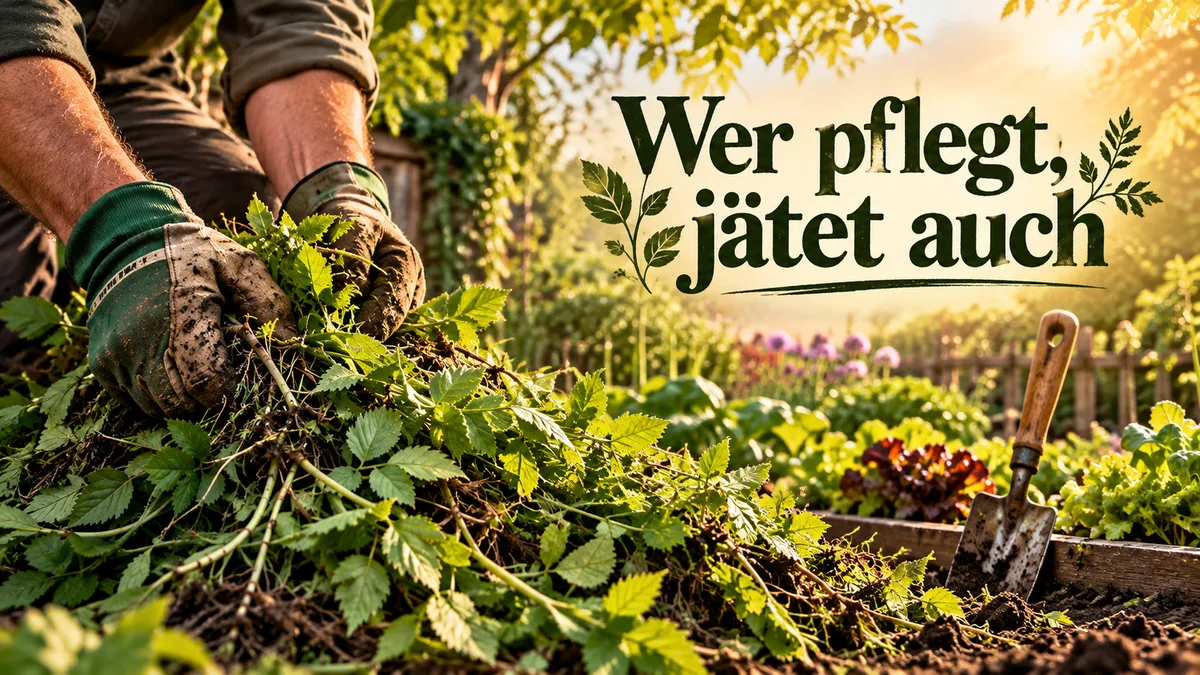
At the center stands the image of the gardener: light, water, soil, patience, and the plant finds its own way. True. Except the gardener is usually holding a hoe in the other hand.
I keep up my parents' allotment garden and enjoy tending it. But tending there also means: the ground elder has to go, the blackberry gets cut back, and the vole has its own opinion about my idea of the becoming. Tending always also means deciding what's allowed to grow. That's not a flaw. It's responsibility, and it should be spoken out loud instead of letting it vanish behind the pretty word “accompanying.”
The biggest example of this sits right outside our city. In 1368, Peter Stromer sowed conifers in the Reichswald – a care measure with the best of intentions. Over the centuries, what emerged was the Steckerleswald, which foresters today are laboriously converting. I wrote about that in “The Forest We Sowed.” Just this much here: even attentive, well-meant care can produce a monoculture.
And the word itself isn't innocent. There's heritage preservation (Heimatpflege), the cultivation of customs (Brauchtumspflege), and the well-tended hedge whose height is set in the garden-plot bylaws. Care can preserve what's alive. It can also hold on to what should long since have been let go.
Whoever tends also weeds. The question is whether they know what it is they're pulling out.
Care by the minute
The essay starts with people from nursing education. All the more, I miss a place where care in that profession gets to speak as it actually is. Anyone who knows someone working in a hospital or a care home knows the stories: too little staff, shifts stretched too thin, documentation that eats up more time than the person in the bed.
That care follows “no logic of production” is true as a description of its essence. As a description of its everyday reality, unfortunately it isn't. Care workers didn't choose the logic of production. It comes down on them as time quotas and billing codes from above.
I suspect a nurse after her third night shift would read the sentence that care is “a way of being in the world” with mixed feelings. It ennobles her work while leaving her alone with it at the same time. A culture of accompanying also needs proper staffing ratios, decent wages, and breaks. Otherwise the lovely term becomes the justification for why everything can stay exactly as it is.
Two atmospheres, separated a bit too cleanly
In the middle section, Schels contrasts two atmospheres. On one side, the authoritarian wave that feeds on fear and enemy images and makes the world smaller. On the other, schools, gardens, and therapy rooms where attention grows and the world becomes more inhabitable.
I share that observation. That fear narrows perception is something everyone knows who has ever chewed on a worry at three in the morning. But the contrast feels too clean to me. It does exactly what the essay accuses the authoritarian side of doing: it turns a complicated situation into a clear-cut opposition. Narrowness here, openness there.
In real life, the lines run right through people. Anyone who's ever been part of an allotment-garden association knows that enemy images thrive between tomato plants too. And someone who does politics with fear, or runs after it, isn't therefore lost to attentiveness. If care really means keeping spaces open, then that has to include those currently stuck in the narrow atmosphere. That's uncomfortable. But it's the part where you find out whether the concept is any good.
Rübezahl wouldn't have a resonance index
At the end, Schels invites an imagined table: the anthropologist Tim Ingold, the thinker Bayo Akomolafe, Cassandra, Icarus, and Rübezahl. I like the idea, especially because of the mountain spirit. After sixteen years of shamanic practice, it's self-evident to me that a landscape is a counterpart, not a backdrop. And the essay's first thought speaks straight from my heart: the sacred never left the river, we just unlearned how to perceive it. That's close to what I always say. You can't go back to nature. We were never away.
Except that in the old legends, Rübezahl was no friendly moderator. He tricked, punished, and led travelers astray when they mocked him. Whoever seats him at the table should expect him to flip it over. The more-than-human world isn't only patient. It's also rough, moody, and funny. So in this gathering, I miss someone who laughs.
Then there's the transparency note at the end: AI index 4/10, resonance index R8, “presentness: high.” I like the openness about the AI share – it should become standard. That a text certifies its own high presentness, though, makes me smile. The most present teacher I have is my cat, Mr. Spock. He's never given himself a grade. He just lies there, like the meadow.
What I'm taking with me
My objections aren't aimed at the direction. I think the shift from producing to accompanying is right, and I try to practice it in every forest session, with mixed success and a lot of patience for myself. What I miss in the essay is just the dirt under the fingernails: the hoe, the duty roster, the grumpy mountain spirit.
For my own forest sessions, in practical terms that means: I keep the space open, but I don't pretend I'm not there. Whoever needs a framework gets one. Whoever would rather lie down in the moss doesn't need one. That's my way of tending the becoming. Sometimes it also means weeding out my own pretty idea of it, because what's actually growing there right now is something else entirely.
The forest doesn't wait for us to understand it. It just keeps growing. I find that comforting.
Source: Michael Florian Schels, “On Tending the Becoming”(External link: Dialogical Aesthetics), Dialogische Ästhetik im Anthropozän, accessed on 08.10.2026.
To wind down: Martin Roth – A Mental Vacation.
Martin Roth – A Mental Vacation
By playing the video, you consent to a connection being established with YouTube. Personal data may be transferred to YouTube. No YouTube content is loaded before you consent.
Would you like to experience the forest yourself?
If an article made you curious, feel free to write to me. Together we will find a suitable date.
Get in touch