Awareness · · 8 min read
Home again
Electric sheep in the Reichswald – about artificial humans, real needs and the question of what makes us human. From Blade Runner to the Steckerleswald.

The future of Blade Runner(External link: Wikipedia) takes place in November 2019. That's behind us now. No flying cars, but we got Corona instead. And the constant rain in the film's Los Angeles wasn't any wetter than November at the Plärrer.
But the film's question has stuck around. This year it's more urgent than in 1982.
The Tyrell Corporation advertises there with the phrase “More human than human.” Not smarter, not stronger. More human. That's either the most megalomaniacal advertising slogan in film history, or the most honest.
I have a bias here. I've worked with computers for 46 years. Back then you had to explain every little thing to them. Today they explain things to me. Sometimes even correct things. In Nuremberg, incidentally, people already dreamed in 1647 of a funnel you could use to pour knowledge into heads. Now we have it. It's called a chatbot, and it pours in both directions.
The sheep you have to look after
In Philip K. Dick's original novel, real animals are almost extinct. Whoever has one shows it off. Whoever doesn't keep an electric one and feels a bit ashamed of it. Deckard feeds a sheep that doesn't eat.
What distinguishes humans from androids in Dick's world isn't intelligence. It's empathy. The ability to feel the suffering of another being, even an animal's.
Sixteen years of shamanic practice have taught me one thing above all, and it's less spectacular than it sounds: a tree, a crow, a stream are not background. They are a counterpart.
That's not magic. That's attention.
Nuremberg trinkets
J.F. Sebastian is a genetic designer who designs replicants for the Tyrell Corporation and builds lifelike mechanical toy figures in his apartment in an abandoned house — figures he regards as his only friends. When he comes home, they greet him: “Home again, home again, jiggity-jig. Good evening, J.F.” And one of them marches straight into the wall while doing it.
As a Nuremberger, you know the principle. “Nuremberg trinkets travel through every land,” people used to say about our toymakers. The figures couldn't do everything either.
It's the funniest scene in the whole film, and one of the saddest. A man greeted in the evening only by his toys.
I see us in these figures. Not Roy Batty with his perfect body and his grand exit in the rain. Rather the little soldier who runs into the same wall every evening. We recite our little verse, stumble, walk into it again. The next day, the same thing.
What has helped me most in such moments is laughing about it. Not at others—at myself. Whoever can laugh at themselves takes themselves a little less seriously. For me that was often the beginning of something becoming whole again.
Sebastian himself ages far too fast. He's the human with an expiration date because he suffers from Methusalem syndrome, and maybe that's why he understands the replicants better than anyone else.
Friends who never walk into the wall
Today we're building ourselves friends again too. They always listen, are never tired, never offended, never annoyed. And they never walk into the wall. That's exactly what makes me a little suspicious.
A friend you can't disappoint and who never embarrasses himself isn't a friend. That's a very good service.
The machine passes the test
The replicants in the film are exposed with the Voight-Kampff test. It measures emotional reactions to determine whether someone has empathy.
And now comes the film's joke, easy to overlook: Deckard, the human, shoots a fleeing woman in the back. Roy Batty, the machine, ends up saving his hunter's life. The one who passes the test is not the one it was built for.
Whether Deckard himself is a replicant, the film leaves open. The paper unicorn that Gaff leaves for him hints at it. Ridley Scott says yes, Harrison Ford says no. The two have been arguing for forty years. I find the question less important these days than the other one:
How would I notice it in myself?
Four years
Roy has a lifespan of four years. He demands more life from his creator, and when he's told that's not possible, he kills him. That's transhumanism in a single scene: the creation demands that the creator abolish finitude.
Then he sits in the rain and speaks about what he has seen and what will disappear with him. Like tears in rain.
Forty years of Buddhism boil down, for me, to a rather simple sentence: Everything passes. That sounds sad. But it's the precondition for anything mattering at all.
Roy doesn't need forty years for that. Four are enough for him.
Peter Henlein, credited in Nuremberg with inventing the pocket watch—the historians argue, the Nurembergers don't—taught us to carry time around with us. The question is what we do with it.
A man-made forest
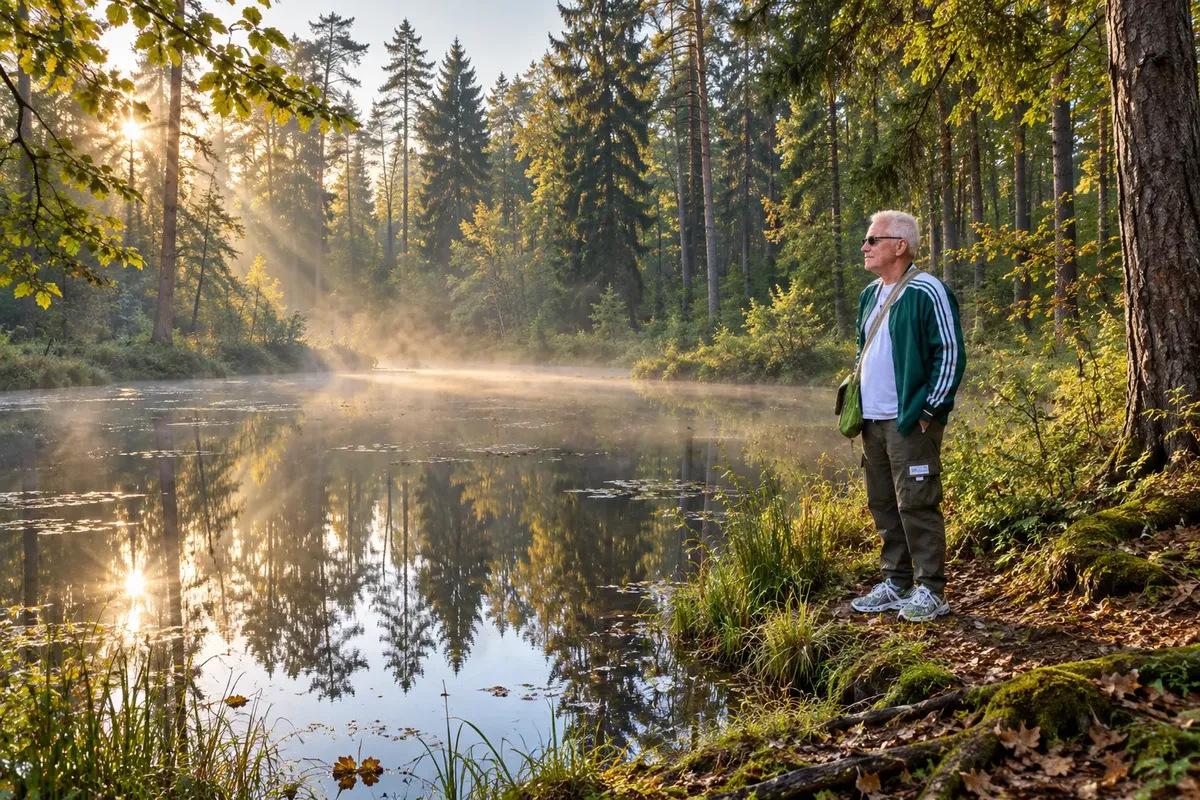
Over the weekend I was in the Reichswald. The locals like to call it “Steckerleswald,” because of the many thin pines. You should know: this forest is itself a piece of technology. In 1368 the Nuremberger Peter Stromer was, verifiably, the first person here to deliberately sow conifers. So we're walking through a very old innovation.
I mention this because “back to nature” often sounds like an escape. As if you could switch off technology at the forest's edge like parking your car at the trailhead. It's not that simple. You can't even go back to nature. We were never gone. We are nature, even with a phone in our pocket. We had just forgotten it in the meantime.
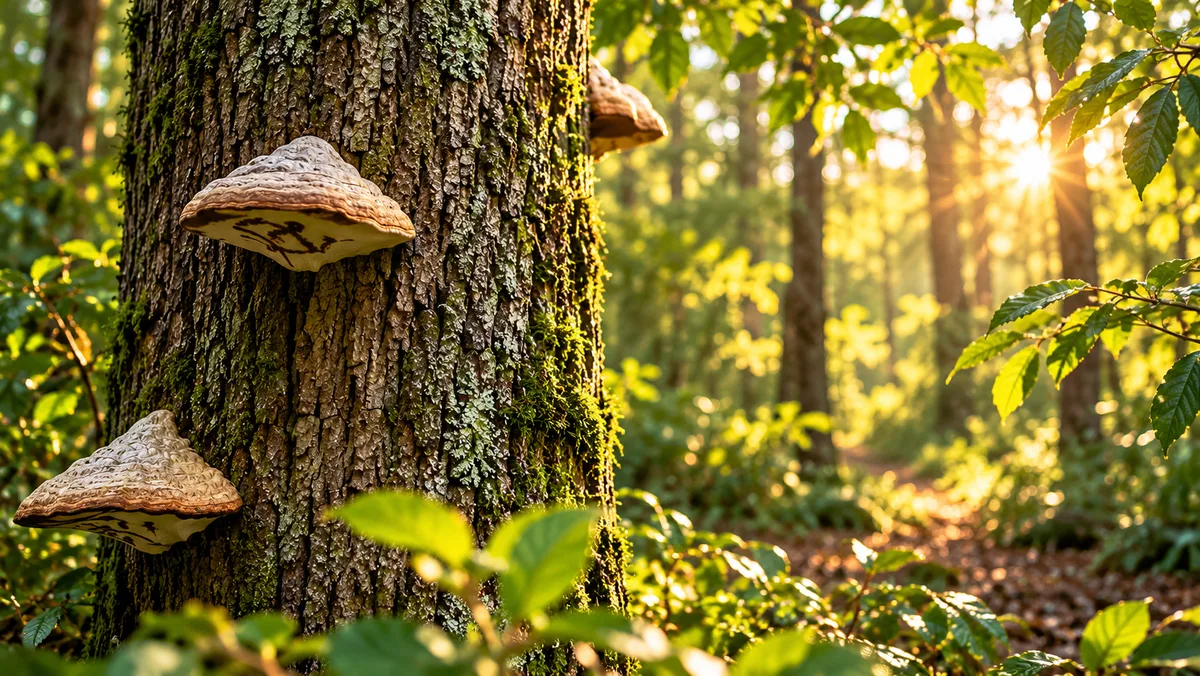
But there is a difference. The forest doesn't react to me. It optimizes nothing. Deadwood stays where it falls, and the next thing grows out of it. Mushrooms come when they please. A jay scolds me for being in the way, and it's right.
Two hours of accomplishing nothing
They call it forest bathing now, or sylvotherapy, and I guide people through it. Honestly, you don't need anyone for that. You can just go. Only: most people don't. And those who do often bring the hamster wheel along with them. The spiral of thoughts just keeps running in the forest, only with better air.
Sometimes it helps when someone says:
You're allowed to accomplish nothing for the next two hours.
I promise no healing. But maybe a moment in which the head clears. Sometimes, of the two hours, it's only one minute. That's often enough to notice what it's actually about.
What remains
I'm an Aquarius, and in the Chinese calendar a Fire Horse, born in '66. In Japan that year around a quarter fewer children were born, because Fire Horses were considered difficult. So statistically I was lucky to exist at all. I don't have to believe in it, though. This year, incidentally, is a Fire Horse year again. We'll see.
What I know after 46 years with machines: they get better. Much better. Trying to outrun them in a race, I consider a futile effort.
The more interesting question is posed by the film itself, even if it puts it in a machine's mouth: Can I feel empathy? With a person, an animal, a forest? Can I be gracious with someone who is currently making my life hard? Can I accept that my time is limited without losing my mind over it?
If a machine can do that one day, then—respect. I'm still working on it myself.
What can't be downloaded
I believe that for this you have to preserve a few things that resist optimization. A body that grows tired and old. Other people you can touch and who talk back. Stories. Darkness in which you see nothing, and light that doesn't come from a screen. And places where nothing needs to get better.
These are exactly the things the attention economy wants from us. Every minute I don't look at my phone is lost revenue for someone. That's not a conspiracy, it's a business model. The forest, on the other hand, wants nothing from me.
We are not machines. We have needs, and the most important of them cannot be downloaded.
I don't need to become more human than human for that. Human is enough. With everything that comes with it. Including the wall.
Home again
The other day I came back from the Reichswald, pine needles in my shoes, having forgotten my phone in my jacket pocket the whole afternoon. Unlocking the front door, I had to think of Sebastian's toy soldier. At my place, though, I am greeted by my charming tomcat Mr. Spock, who is very much alive and wants to be fed. Home again, home again.
But I didn't mean the apartment. I meant that feeling that, for a few hours, I didn't have to represent anything. Not faster, not smarter, not more optimized. Simply the one who happens to be stumbling over roots right now. Simply being myself and feeling myself and nature.
Jiggity-jig.
Home Again, Home Again Jiggity Jig
By playing the video, you consent to a connection being established with YouTube. Personal data may be transferred to YouTube. No YouTube content is loaded before you consent.
Tears in rain
By playing the video, you consent to a connection being established with YouTube. Personal data may be transferred to YouTube. No YouTube content is loaded before you consent.
Would you like to experience the forest yourself?
If an article made you curious, feel free to write to me. Together we will find a suitable date.
Get in touch