Awareness · · 6 min read
Underneath Lies the Forest
An essay full of awkward words, a tuft of weeds from 1503, and the question of what a forest guide actually does. Spoiler: not much.
I came across an essay containing words like “Gehenwahr” and “Fürwart.” It's called From Overwriting to Uncovering(External link: Dialogical Aesthetics) and is by Michael Florian Schels. On first reading, I thought the autocorrect had gone haywire. On the second, I got stuck.
Schels starts with Romulus, who draws a furrow with his plow around his future Rome and kills his brother for jumping over it. Later, people prefer to tell the story of the she-wolf instead. The essay calls this overwriting: over what is really there, or what really happened, a layer of myths, concepts, and purposes gets laid down.
Today this happens without a plow. The forest is building land, a raw-material depot, or a recreation zone, depending on who's looking. Amid all the labels, you can no longer see the pine tree. The opposite, in Schels's terms, is uncovering: sometimes not piling anything on top. Possibly even taking something away.
I felt caught out. In this very space, I've already laid Alice in Wonderland, Monty Python, and most recently Blade Runner over the Reichswald. So I'm sitting in a glass house. I'll throw stones anyway, but only further down.
A tuft of weeds
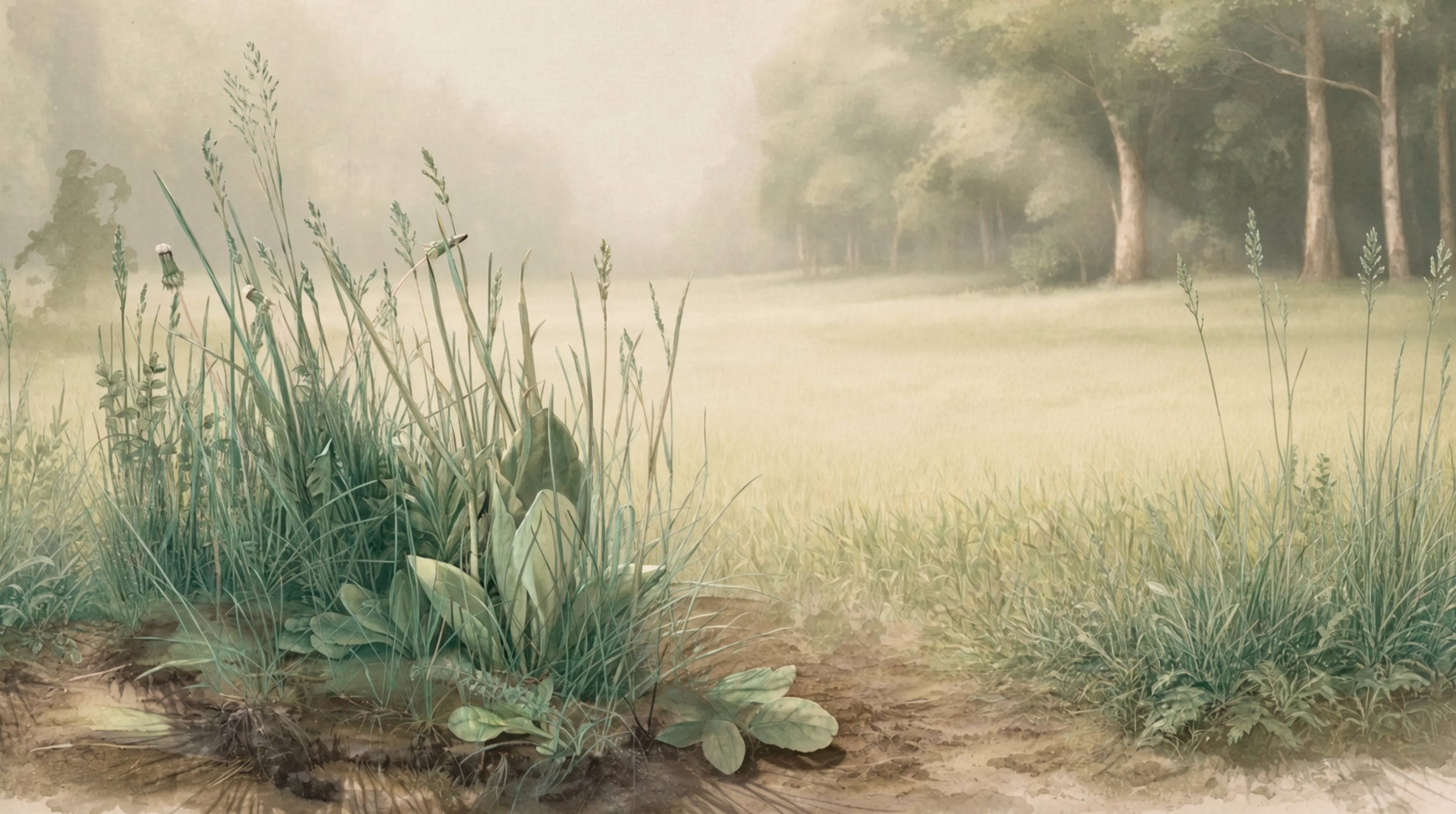
In Nuremberg, someone already demonstrated this uncovering once before. In 1503, Albrecht Dürer painted a patch of meadow. Dandelion, plantain, a few grasses, and underneath you can see the soil. No saint, no emperor, no message. The Large Piece of Turf shows what stands at the edge of every path, and does so with such precision that the plants can still be identified today.
The sheet hangs in Vienna, which Nuremberg bears with composure.
Dürer added nothing to the meadow. He apparently bent down quite far and looked long enough. That's the whole program. It's a good five hundred years old and fits on a single sheet of paper.
He didn't pile anything on. He simply didn't look away.
Three old words
The essay describes three postures, and I can make use of them.
The first is called uprighting. Getting out of a stooped posture, feeling one's own stance. After nearly fifty years in front of screens, I know that this is initially a matter of the spine. But more is meant: standing there without making oneself smaller and without taking someone else's place.
The second is called being inclined toward. Turning toward a person or a place without immediately evaluating, explaining, or fixing it. This is hard for me. I come from a profession where you search for and fix errors. But a pine tree has no bug. The person walking next to me, incidentally, doesn't either.
The third is called lingering. Staying in a place without anything needing to come of it, not even a photo. It's the most beautiful of the three and the least popular. Anyone who stands around somewhere for ten minutes without checking their phone is either waiting for the bus or arousing suspicion.
Not every moment needs a purpose. Some just need time.
Gehenwahr and Fürwart
That leaves the two invented words. Gehenwahr means that one doesn't grasp a place while sitting, but while walking. For Schels, the foot is not a means of transport for the head, but a sensory organ. In the Reichswald, that means: sand underfoot, roots I trip over with lovely regularity, and the smell of resin when the sun is on the pines. The word is clunky; the thing itself isn't. Anyone who has ever walked barefoot along a field path knows it.
Fürwart is the counterpart to “forward” (Vorwärts). The essay speaks of a walking that accompanies rather than conquers. One that can hesitate and pause, and before the next step asks whom it serves. Schels hears the word “waiting” (Warten) resonating within it.
There I can help. In Franconian dialect there has long been a phrase for this, and it manages without any neologism:
Edz ward hald amal... (roughly: “Now we'll just have to wait and see...”)
Where I get off
Now for the stone from the glass house. The essay doesn't stop at experience. In the epilogue, it brings in Rupert Sheldrake's morphic fields and the physics of entanglement: two people lingering together in a forest hollow are supposed to build up a “counterfield” that changes the state of the overall system.
That's where I get off. Entanglement is well documented for particles in a lab. For two people in a forest hollow, it is not. And as for morphic fields, natural science has to this day found no evidence for them.
I say this as someone who has practiced shamanism for sixteen years and has no problem with things that are hard to measure. It's just that you shouldn't then express them in units of measurement. The experience is strong enough. It doesn't need borrowed physics.
On top of that come nearly a dozen philosophers, biologists, and physicists summoned as witnesses. The essay itself warns against merely countering overwriting with the next theory. Then follows a glossary in five sections. Anyone who notices after an hour in the forest that their shoulders have dropped doesn't need a footnote for that.
Whoever explains uncovering for so long that nothing remains uncovered has overwritten it.
This article is no exception. So I'll keep it brief.
Schels discloses at the end that his text came about in dialogue with an AI, eight out of ten on his own scale. I credit him highly for that.
As someone whose main profession for nearly fifty years has been IT and software development, I too naturally use AI. Strictly speaking, I'm even an expert in AI and agentic software development. AI is, first and foremost, another tool for sorting, classifying, and structuring thoughts.
In earlier times people used typewriters, then flip charts and mind maps, then word-processing software, then spell-checkers, the internet for research, and many other helpful tools; today AI takes over much of that. Used properly, it's a blessing, though it can very easily become a curse too. It's in our hands. But that's only a side note — after all, this is about forest guiding and a counterbalance to our ever-faster-changing world.
What I actually do
So what does a forest guide do, then? The honest answer: not much. I know a few paths. I keep an eye on the time, so no one else has to. And I try to keep my mouth shut at the right moments, which as a Franconian comes more easily to me than as a writer.
I can't bring anything about. The forest is not a therapist, and I am not someone who knows the answers. Sometimes nothing happens in two hours, except that someone gets wet feet.
And as I've said before: you don't need anyone for this. Dürer didn't have a turf-guide either. What he did have, though, is something most of us have lost. He was allowed to look at weeds for hours and call it work.
Today, someone sometimes has to give us permission to do that. My occupation is, more or less, not much more than that.
Coming to a stop
For anyone who wants to try it: on your next walk through the forest, stop at a spot where there's nothing to see. A stretch of path edge, moss, pine needles, a bit of grass. Look at it until it gets boring. Then one more minute.
That's about all the method I have for simple forest guiding. Maybe also pay attention to your own breath. Underneath the labels, the plans, and the footnotes lies the forest. It was there the whole time.
Edz ward hald amal...
Image credit: Albrecht Dürer, The Large Piece of Turf, 1503, Albertina, Vienna. Artistically adapted and extended using AI.
This music video belongs with the text: „now“ by John Pattern. Like “Drunter liegt der Wald” (Beneath lies the forest), it is about the quiet that lies beneath the surface — listen to what words cannot say.
“now” – John Pattern (music video)
By playing the video, you consent to a connection being established with YouTube. Personal data may be transferred to YouTube. No YouTube content is loaded before you consent.
Would you like to experience the forest yourself?
If an article made you curious, feel free to write to me. Together we will find a suitable date.
Get in touch