Awareness · Activism · History · · 6 min read
The Forest We Sowed
Beekeepers, pines, protected forest: a short history of the Reichswald and humanity’s tendency to put everything in order until it breaks.
My allotment garden is honest. The tomatoes stand in rows, and nobody mistakes that for wilderness.
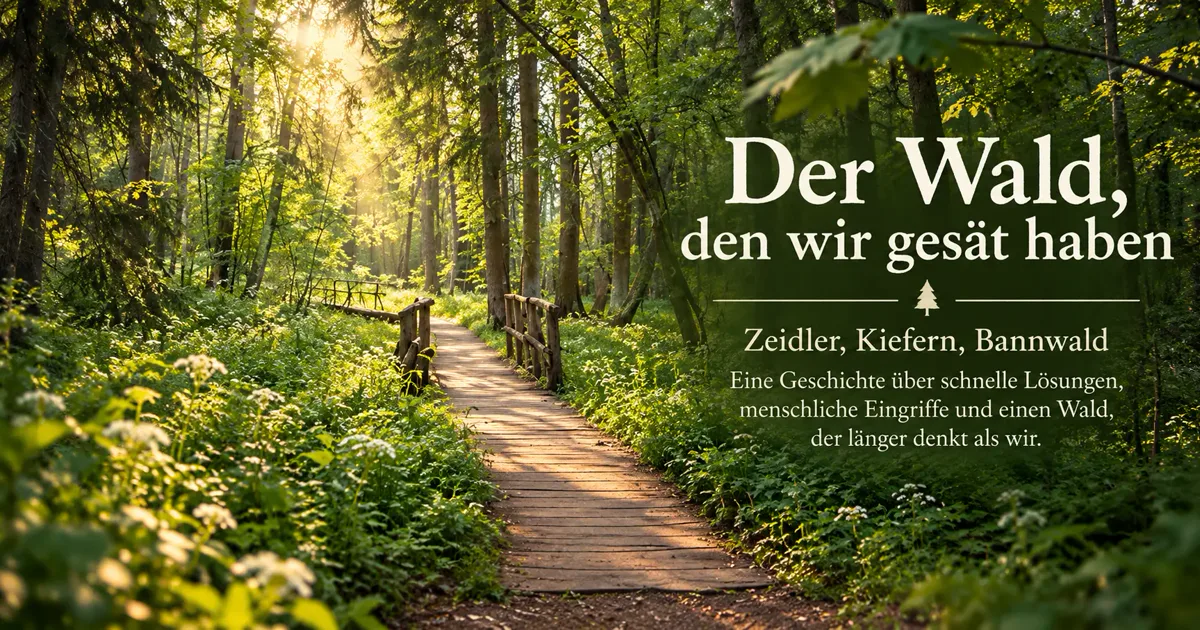
The Reichswald is more cunning. It looks like nature: pines, sand, moss, blueberries. Yet forest historians call it the cradle of forestry. A good part of what’s standing here was sown by people.
Nurembergers call it the Steckerleswald — “stick forest” — because of the thin, bare pine trunks standing there like sticks. That sounds affectionate. It wasn’t always meant that way. More on that shortly.
A Court for Bees
Reichswald means “forest of the Empire.” It belonged to the king, and later the Imperial City administered it. North of the Pegnitz lies the Sebalder forest, south of it the Lorenzer Reichswald, both named after the two great churches. A forest with jurisdictions, in other words. We’ve always been good at that.
Even the bees had a legal status. The Zeidler — forest beekeepers — didn’t keep their colonies in boxes; they tended them in the trees of the forest and harvested honey and wax. Charles IV enshrined their rights and duties in a charter in 1350. In Feucht, a dedicated beekeepers’ court sat until 1796. The forest was called “the Holy Roman Empire’s bee garden,” and its honey went into Nuremberg gingerbread.
A court just for bee matters. Anyone complaining about bureaucracy today underestimates the Middle Ages.
The Quick Fix of 1368
Nuremberg needed wood. For building, for heating, for the smelting furnaces. By the 14th century, overexploitation had worn the forest down so badly that things got tight.
At Easter 1368, city councillor Peter Stromer began sowing conifers: firs, spruces and, above all, pines. It is the first documented conifer sowing. Stromer was a mining entrepreneur, so he needed the wood himself too. And it worked. The city had construction timber again.
I’ve worked with computers for almost fifty years, and I know this moment. A quick fix, it runs, everyone’s happy, and nobody asks what it will cost in a few centuries. In my field we call that technical debt. Stromer solved one problem and ordered the next.
The first bill came due in the 1890s, when the pine looper moth stripped large parts of the monoculture bare. The second is arriving right now. Pines are dying across the Reichswald on a larger scale. They can tolerate drought, say the state forestry authorities — just not combined with heat. And the heat is rising: according to the forestry agency, temperatures there already match what a mild climate scenario had only predicted for the year 2100.
You can’t really blame Stromer for that. He did what we all do: the obvious thing.
The pine was the quick fix. It has now been the quick fix for 650 years.
How a Mocking Nickname Almost Cost the Forest
In the early 1970s the Reichswald seemed lost. Land was cleared for roads and housing developments, and the justification was usually: it’s just a stick forest. It doesn’t deserve better.
First we impoverish the forest, then we hold its poverty against it. I know that pattern from more than just the forest.
Nurembergers fought back. In 1979 the Reichswald became the first forest in Bavaria declared a protected forest — a Bannwald. That means the forest takes precedence. In the Middle Ages the king placed his ban on the forest so no one else could enter it. Now we place one on it so that we ourselves stay out — with the excavator, at least.
It has been under reconstruction ever since. Among the old trees, the share of broadleaf species is around ten percent according to the forestry agency; in the young generation beneath them, it is over fifty. Up top the sticks still stand; down below, things are getting colourful.
Oaks, Norway maples and wild service trees are being planted, and lately sweet chestnuts too, with cedars as an experiment. Cedars in the stick forest — Stromer never would have dreamed of that. Whether this is the next quick fix, we’ll know in two hundred years. A forest just can’t be rebuilt as fast as software — and software always takes longer than planned anyway.
We’ve spent a good forty years repairing what we spent six hundred years optimizing.
Does the Forest Need Me?
The other day I wrote here that the forest wants nothing from me. I still stand by that. It doesn’t wait for me and doesn’t rejoice when I show up. If I sit on a tree stump for two hours accomplishing nothing, it’s indifferent to that.
Still, wanting and needing are two different things. This forest wouldn’t exist anymore if people hadn’t sown it, tended it and defended it in 1979. It doesn’t need my attention. My voice, when the next road gets planned — that it might well need.
That’s not theoretical. Deutsche Bahn wanted to build an ICE maintenance depot in the Reichswald, 35 to 45 hectares in size. Under discussion were, among other sites, the former Muna munitions site near Feucht, the Jägersee and Harrlach. Citizens’ initiatives and the Bund Naturschutz fought it for years. In April 2023, the railway abandoned the plans.
An ICE depot isn’t an evil thing. It just doesn’t belong in a protected forest. The fact that it isn’t there is not something the forest managed on its own.
I’m attached to this forest. As a child I was here often, with my grandparents and my parents, mushroom-picking. Back then I looked at the ground. Today I look up into the crowns more often, and what I see there doesn’t always please me.
And I have to stay honest about myself, too. The Reichswald was a timber store, a bee garden and an ammunition depot. Now it’s a recreational space, and I lead people into it. I’m the newest use in a long line. At least the quietest one.
Please, No More Optimizing
What I take from this story isn’t “back to nature.” This forest was never untouched nature to which one could return. What I take away is a distrust of quick fixes — including my own.
Some calendars look like a pine plantation. Everything in rows, everything fast-growing, everything geared towards output. That works fine for a long time. Then comes a hot summer.
A mixed forest is the opposite. It grows more slowly, looks messier, and some of it yields nothing at all. But it is still standing when things get tight. Two hours of accomplishing nothing is, seen that way, a broadleaf tree in the calendar.
A bit of a mess never hurt a forest yet.
The Reichswald Festival
If you want to see what it looks like to give a forest a voice: since 1973, the Bund Naturschutz has invited people every summer to the Reichswald Festival on the Schmausenbuck. The recipe has been Franconian-simple from the start: music, beer, something decent to eat and a few speeches. About 500 people came to the first festival; today it’s thousands.
In between lie a tank training ground near Feucht, a planned Autobahn interchange at the Tiergarten and the ICE depot. None of the three exists.
Today the festival also includes guided tours, tree climbing and a children’s programme. The next Reichswald Festival is on 10 and 11 July 2027. The Sebalder, Lorenzer and Southern Reichswald together cover about 36,000 hectares. So there’s room.
More from the Bund Naturschutz on the Reichswald Festival(External link).
Barac – Try to be a rainbow in someone else's cloud
By playing the video, you consent to a connection being established with YouTube. Personal data may be transferred to YouTube. No YouTube content is loaded before you consent.
Would you like to experience the forest yourself?
If an article made you curious, feel free to write to me. Together we will find a suitable date.
Get in touch