Awareness · Nature connection · · 6 min read
Rübezahl is in a bad mood
On an essay that renames the present, three legendary figures without shadows, and whether the forest is pleased when I arrive.
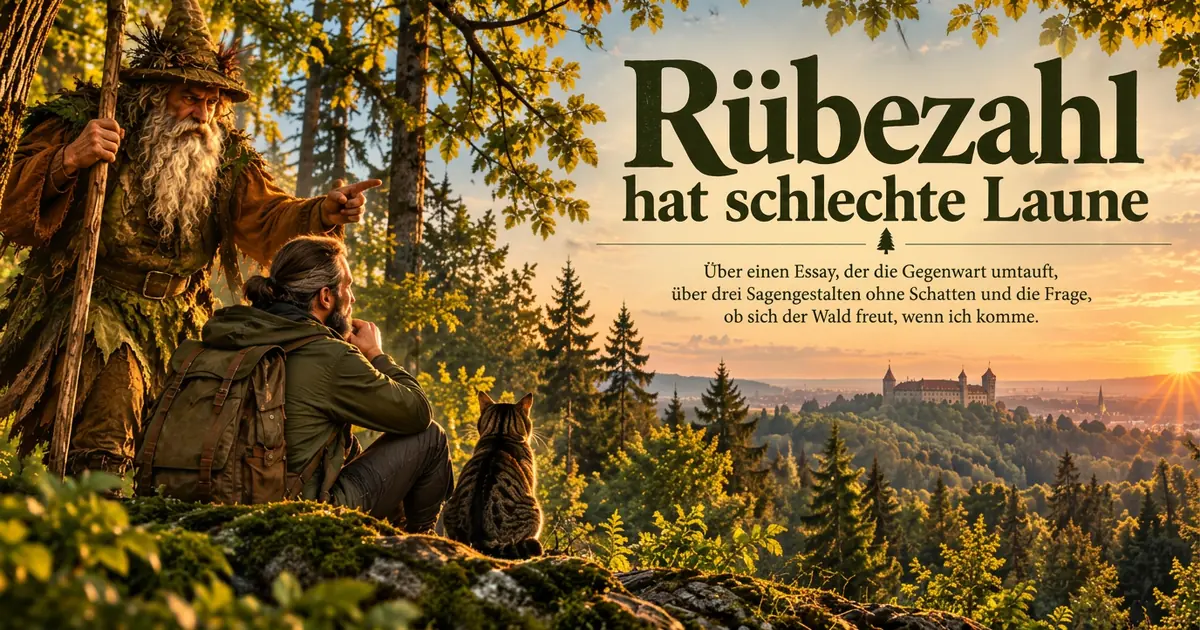
I read an essay in which the present is given a new name. It is called “Fürwart”. The moment is imagined as a wide space in which what is coming already rests like a seed in the soil. Michael Schels wrote it in dialogue with an AI. He says so openly at the end, and I give him credit for that.
There is much in it I agree with immediately: that a tree is more than scenery, that attention is a form of participation. And there is one sentence I wish I had written myself: that we might keep the world company.
Still, I grew uneasy while reading. It took a while to understand why. Nothing goes wrong in this text.
A word that can already do everything
The author hears caring waiting in “Fürwart”. That is charming, but the German word Gegenwart, the present, has nothing to do with waiting. Its “-wart” is related to “-wärts”, as in heimwärts—homeward: turned towards. In Old High German the word meant something lying before one’s eyes; as a noun, even countenance and face.
Gegenwart is therefore, literally, what looks me in the face. The old word can already do what the new one was invented for.
And the idea that in the moment everything is interwoven and nothing arises by itself is called dependent origination in Buddhism. It is about two and a half thousand years old. I have been sitting with it for forty years and am not finished yet.
I have nothing against new words. I merely suspect that a new word can sometimes spare us the work the old one demands.
The present does not care what I call it.
Three figures without shadows
Three companions appear in the appendix: Rübezahl, Cassandra and Icarus. There Rübezahl teaches lingering, Cassandra teaches sensing, and Icarus teaches courage. I know all three differently.
In the old legends, the lord of the Giant Mountains is no mindfulness teacher. He sends thunderstorms after hikers and leads them astray. Anyone who calls him Rübezahl has already lost: it is his mocking name, because he allegedly once counted turnips, and he does not like being reminded. On the oldest map that depicts him, from 1561, he has antlers, a hoof and a tail.
Cassandra sees the fall of Troy coming, and nobody believes her. That is her curse: to be right and not be heard. In the essay she hears “what approaches in the wind”. In the legend, it is the Greeks.
Icarus flies too high despite his father’s warning, the wax melts, and he falls into the sea. In the essay he stands for the courage to set out, explicitly also for the encounter with artificial intelligence. There is not a word about the fall. Icarus without the fall is a travel brochure.
The three have endured because something goes wrong in their stories. Take that away and three friendly coaches remain.
I would not say that to Rübezahl’s face. Especially not using that name.
Is the forest pleased when I arrive?
The essay’s strongest sentence is: “The world senses us as we sense it.” Sometimes, the author writes, it seems as though the landscape breathes easier when someone lingers with it. To be fair, he says “as though” and concedes in the appendix that science provides no evidence for this.
My experience is different. The forest does not respond to me. In the Reichswald, at most a jay greets me—and it scolds because I am in the way.
In my allotment garden, slugs eat all my lettuce. They mean no harm. Only humans know such categories. I think: enjoy it, you slugs; I will eat something else. And I take pleasure in looking at them. Or I ask a leopard slug for help, since it eats the others.
From shamanic practice I have learned that a tree, a crow or a stream is not background. Each is a counterpart. I stand by that. But a counterpart is one precisely because it is not there for me. A forest that breathes easier as soon as I finally pay attention would once again be only a mirror. I would again be the customer, just with more refined service.
It relieves me that the forest does not need me. In everyday life someone constantly wants my attention. Outside, nobody does. I may give it away, and nobody says thank you.
The forest wants nothing from me. Not even my attention.
A resonant space that never contradicts
The essay’s terms emerged in dialogue with an AI. They were supposedly “uncovered” there; the machine was described as a resonant space.
I have worked with computers for almost fifty years, and I like them.
A machine also helped with this text. It contradicted me because I instructed it to. That is the catch. It contradicts on demand.
Throw a word to a language machine and it returns it more beautifully. That feels like resonance. Yet sociologist Hartmut Rosa, who made the term prominent, insists on a distinction: resonance needs a counterpart with a voice of its own, one that can also contradict. Everything else is echo.
This applies equally to the machine and the three legendary figures. The machine is built for agreement. It has been taught Rübezahl, Cassandra and Icarus. I put it this way elsewhere: A friend you cannot disappoint is not a friend. That is very good service.
I recognise a counterpart by its ability to spoil my mood.
Lingering as a checkbox
At the end of the essay is a guide generated from the text by a second AI. It contains step-by-step exercises and a daily checklist: Did I straighten myself today? Did I incline towards something? Did I linger?
Earlier the essay observes that modernity has sorted time into appointments and deadlines. A few pages later, lingering itself is an item on the list. That is how you take the hamster wheel into the forest. It keeps turning there, only with better air.
I say this without malice. I offer forest sessions, with a time and meeting point. It sounds contradictory. It is.
What I take with me
The sentence about keeping company. It is good, and remains good when followed to its conclusion. Whoever keeps someone company expects nothing in return. They simply sit beside them.
So next time in the Reichswald I will keep the world company and assume it does not notice. And if it starts raining, I know whom to address. He may live in the Giant Mountains, but to be safe I shall call him “Lord of the Mountains”.
Keeping the world company. Even when it has not ordered any.
Michael Schels: “Die Fürwart”(External link: Dialogical Aesthetics)
GAS conveys feelings of nature, hallucination, loneliness and a dense, intoxicating forest atmosphere rather than a narrative message: you enter the forest. Everything slowly becomes strange.
GAS – POP 2000
By playing the video, you consent to a connection being established with YouTube. Personal data may be transferred to YouTube. No YouTube content is loaded before you consent.
Playlist: “RÜBEZAHL – The mountain forgets nothing.”
🌲 Forest → 🌫️ Mist → 🏔️ Mountain → 👁️ Encounter with the mountain spirit → 🔥 Transformation → 🌌 Return
- GAS – Pop 4 – You enter the forest. Everything slowly becomes strange.
- Recondite – Levo – The path climbs; mist gathers and orientation shifts.
- Basic Channel – Quadrant Dub I – Time loses its meaning. A powerful “mountain spirit” moment.
- Transient Disorder & Mono Sapiens – Mountain Spirit (Misaya & Ajana Remix) – The true Rübezahl moment.
- Daniel Avery – Drone Logic – An opening upwards, with a cosmic character.
- Barker – Paradise Engineering – Transformation and insight.
- Yagya – The Salt On Her Cheeks – Returning from the vision.
Would you like to experience the forest yourself?
If an article made you curious, feel free to write to me. Together we will find a suitable date.
Get in touch