Awareness · Nature connection · · 4 min read
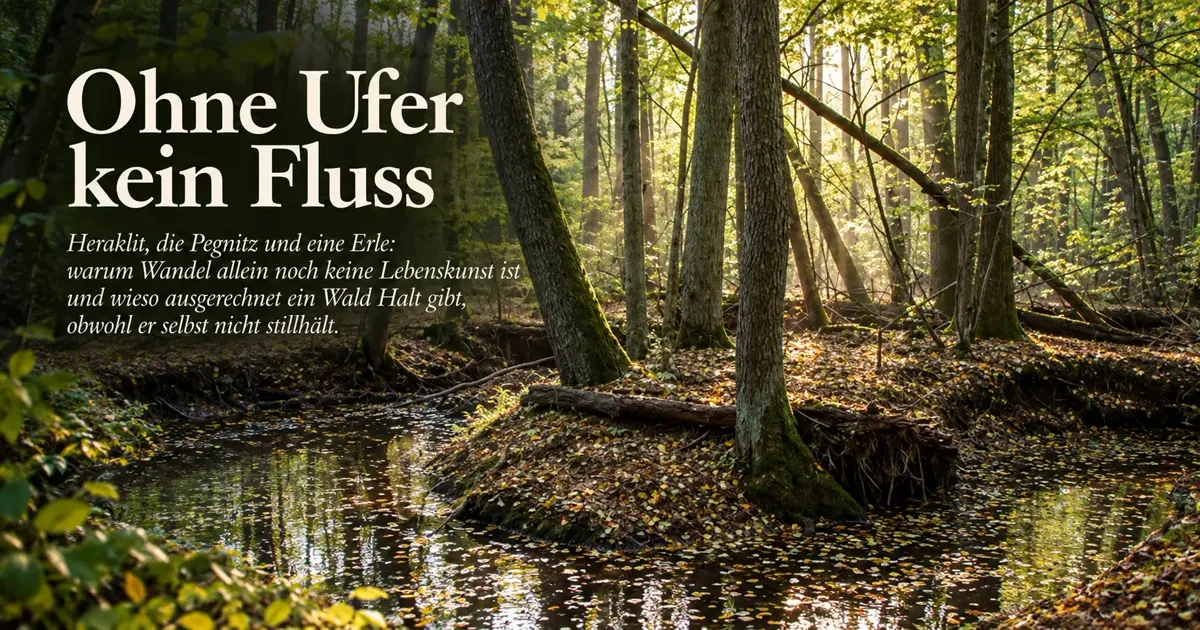
No river without banks
Heraclitus, the Pegnitz and an alder: why change alone is not yet an art of living, and why of all things a forest gives us footing, even though it never stands still itself.
“Panta rhei” (Greek: πάντα ῥεῖ) – “Everything flows.” The phrase appears on calendars, in coaching brochures and probably on at least one shower curtain. It is said to be Heraclitus. He most likely never put it that way.
What has come down to us is more precise: those who step into the same rivers are met by ever different waters. The same rivers, different water. So two and a half thousand years ago the man already knew that something remains while things flow.
Today it is mostly turned into an instruction. Change is good, be flexible, stay adaptable, find the right little screw to adjust. For me that is all a bit too quick.
What the calendar leaves out
The philosopher Wilhelm Schmid pointed to something the calendar saying leaves out. A river is only a river because at its edge there is something that does not flow. A bank.
Water without banks is not a river. It is a flood. Nobody in Nuremberg needs that explained. In February 1909 the Pegnitz stood in the Hauptmarkt.
But the Pegnitz teaches something else, too. Over centuries, water wheels and fixed weirs had taken away its room. A bank can also be too narrow. Then the water comes all the more.
Schmid says that today the banks themselves have started to flow. In the past, for all the change, there was a framework: a ruler, a firm faith, settled knowledge. I don't miss every one of those banks. Some were walls. But when nothing at all stays fixed, nobody can bear it for long.
Heraclitus could have known, by the way. He lived in Ephesus, a port city. Over the centuries the river silted up the harbour. Today the ruins lie a few kilometres from the sea.
The bank flows too. It just takes more time.
Too fast for whom?
I have been working with computers for almost fifty years. On my C64 I spent hours typing in program listings just so I could play afterwards. Loading a big program from the cassette drive could take up to forty minutes.
Today you could do the same on the go, with a voice command to your smartphone. The thing is roughly a million times faster than my C64 and hooked up to half the world's knowledge. Everything has become faster since then. Except me.
My body is essentially the same model as a few thousand years ago. It needs its sleep, and it needs three days to arrive on holiday. A clear thought takes as long today as it did in Heraclitus' time. There are just a hundred times more interruptions in between.
I don't believe the machines will destroy us one day. I think something else is more likely, and dangerous enough: that we make the important decisions at the pace of breaking news. How we deal with the climate, with the forests, with the machines themselves. All of them questions that need a calm mind, in an age that leaves none to spare.
I don't want to demonise technology for that. It is a tool, and a good one. The only question is who sets the pace.
Along most streams around here grows the alder. It keeps its feet in the water, and its roots hold the bank together. So the bank is nothing dead. It is something alive that grows slowly and holds on as it does.
The alder is stable, but not rigid. In a storm it bends. A tree that can't do that breaks. Today this is called resilience, and there are seminars for it. The alder does it without a word: hold on below, give way above.
That is the first thing I learn from the forest. The second is its pace. The forest flows too. It grows, dies, changes, and here in the Reichswald it is doing so faster right now than is good for it. But it does so at a speed I can keep up with.
That's why I go in when everything gets too fast. Nothing gets healed there. My mind simply catches up again. For two hours I have a bank.
Stable doesn't mean rigid. Every alder knows that.
Why now
I'm not fooling myself. Two hours in the forest won't save the climate. And we don't need to save the planet anyway; it will manage without us. It's about us. We are part of what is starting to slide right now.
A clear mind doesn't solve a single one of these problems. It is only the precondition for tackling them sensibly at all. I, at least, have never made a good decision in a hurry. And you plant a bank before the flood comes.
That it can be done I see right on my doorstep. Beneath the old pines of the Reichswald, young mixed forest now grows on more than half of the area. People planted it, within forty years. Humans can change course when they want to.
For me, that is the real hope in the old saying. If everything flows, then the bad things won't stay as they are either.
Everything flows. That also means: it can still get better.
More about the protected natural forest: Naturwald “Feuchtwälder im Nürnberger Reichswald”(External link: Naturwald Bayern)
I chose the album Alpe Lusia by Stimming – and especially its first track, Prepare – because it carries almost everything this forest story touches on. The album “Alpe Lusia” was created after an extended retreat to a secluded mountain hut in the Italian Alps. The aim was to create “artificial understimulation” by switching off modern distractions and the sensory overload of digital society. This allowed the artist to reconnect deeply with his studio equipment and incorporate raw recordings of nature and the surrounding environment, such as cowbells.
Stimming – Prepare – Alpe Lusia
By playing the video, you consent to a connection being established with YouTube. Personal data may be transferred to YouTube. No YouTube content is loaded before you consent.
Would you like to experience the forest yourself?
If an article made you curious, feel free to write to me. Together we will find a suitable date.
Get in touch