Nature connection · Awareness · Research · · 6 min read
The forest works the night shift
An essay describes the earth as sleeping and waking at the same time: one part always rests while another is awake. I wondered what you see in the forest if you stay until the day ends.
Recently I came across an essay I liked. It is called “Die schlafende und die wachende Erde”(External link: Dialogical Aesthetics) (“The sleeping and the waking earth”), written by Michael Schels and published on his site “Dialogische Ästhetik im Anthropozän”. In the evening, Schels writes, the earth turns out of the light, windows go dark, people go to bed, and somewhere else the morning begins. “The earth sleeps and wakes at the same time. One half rests. One half moves through the day.”
What I like is that this is not an either-or. On earth, one part is always awake while another sleeps. Our attention also changes over the course of the day. And as it grows, the world moves closer with it: we notice what surrounds us; it appears before us, so to speak. I see it in much the same way.
What I like about the text
The essay opens with an observation everyone knows. Our thoughts run ahead of us, the day passes in the calendar, and meanwhile light falls across a wall without anyone looking. That attention settles as you breathe out is something I can confirm. It is banal, and it works anyway.
And Schels promises no miracles. “Problems do not dissolve,” he writes, “space opens up between them.” I would sign that straight away. I do not promise more either.
I also find his thought about AI apt. A machine can talk about sunrises, but the sunrise happens where someone stands and feels the cold. I like working with AI, on this article too. In the forest, I am still the one standing there.
The night shift
If you stay in the forest in the evening, you see how waking and sleeping are distributed. The sleeping half is not empty; it simply has a different cast.
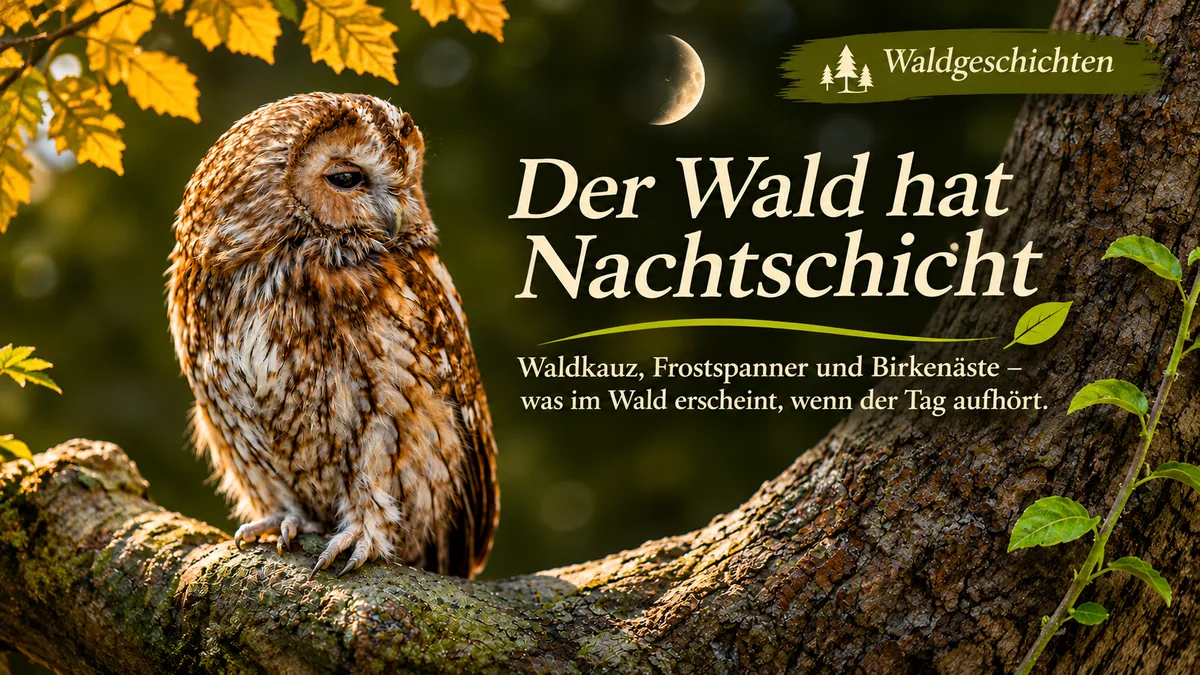
At the forest edge, shortly after the sun has gone, the day shift stops talking and the other one starts. The tawny owl is nocturnal, and its song sounds like a drawn-out “hoooooo-hu-hoooooo”. If you have never heard it, the first time you might easily take it for something else.
Now, in late autumn, another cast joins in that hardly anyone knows: the winter moths. The mottled umber is active mainly in October and November, the winter moth hatches from early November. Both fly when most insects have long since clocked off, and only the males do, grey-brown and inconspicuous. The females have no wings. They climb up the trunk and call the males with scent. In spring the caterpillars feed on the leaves of oak, beech and hornbeam, so much so that the Bavarian State Institute of Forestry counts the females on the trunks. An insect that flies in the frost of all things has simply understood the season in its own way.
Even the trees are not simply switched off at night. In 2016, researchers from Finland, Austria and Hungary used laser scanners to watch two silver birches overnight. Branches and leaves drooped, by up to ten centimetres on a tree about five metres tall. Two trees, no wind, equinox: that is not much material. Whether you may call it “sleep” is an interpretation. Whether a pine in the Reichswald does the same is written nowhere. I do not know.
The earth sleeps and wakes at the same time. In the forest, only the shift changes.
It is no different with us humans. Somewhere, someone is always on the night shift, in the bakery, in the hospital, at the station.
Connected, just forgotten
Schels writes that the world appears before we explain it. I would like to add something important to me: we are an inseparable part of nature. We have just forgotten it. The stress of everyday life, its demands and all of modern technology contribute to us feeling separate. You cannot return to nature; we were never away.
That is exactly why I think forest time makes sense: to experience and feel this connection directly again. As a place of strength, the forest can help us withstand the challenges of modern times a little better. That is not a promise, more of a practice.
I have two small observations to add, as additions rather than criticism. In places the essay stays general: “A bird call crosses the morning.” At such moments I would like one particular bird in one particular place, like the owls above. And the essay says that in difficult moments the tightness eases. That can happen. It does not have to. In 2017, Lindahl and colleagues(External link) documented a wide range of challenging experiences among meditators. If you are in an acute crisis, a doctor or therapist will serve you better than my forest walk. I promise neither healing nor relief. At best, there is a clear moment.
One minute for your next evening
One evening, shortly after sunset, go to a forest edge you know. Take a torch and stay at the edge; there is no need to go into the thicket. Stand still and listen for a minute to what stops and what begins. If you like, breathe out a little longer than you breathe in, once. That is all it takes.
If you hear nothing, that is a result too. The tawny owl does not come on demand.
In closing
Schels describes how the world appears as attention grows. I think this reverses what we usually do. We lay an image over the world and wonder why it does not fit. The tawny owl does not call on demand, and the winter moth female climbs up the trunk whether it fits my picture or not.
That is what I think forest time is good for: for two hours, the world does not need to be put right. You are allowed to fit into it.
“We try to make the world fit into what we think it should be, instead of trying to fit into the world.”
To watch and listen
Two pieces accompany me on this topic, both without words, both with plenty of space in between.
The first is “Says” by Nils Frahm. It begins with a single, steady pulse that builds and carries over several minutes. The official video by Erased Tapes shows ink on glass, improvised live, without post-production.
Nils Frahm – Says (Official Music Video)
By playing the video, you consent to a connection being established with YouTube. Personal data may be transferred to YouTube. No YouTube content is loaded before you consent.
The second is “An Ending (Ascent)” by Brian Eno from the album “Apollo” (1983), here set to images by Andrei Tarkovsky. If you only listen to one, make it this one, ideally in the evening and without a phone in your hand.
Brian Eno – An Ending (Ascent)
By playing the video, you consent to a connection being established with YouTube. Personal data may be transferred to YouTube. No YouTube content is loaded before you consent.
Sources
- “Die schlafende und die wachende Erde” (The sleeping and the waking earth), Dialogische Ästhetik im Anthropozän (German)(External link: Dialogical Aesthetics)
- Puttonen et al. 2016: Quantification of Overnight Movement of Birch (Betula pendula) Branches and Foliage with Short Interval Terrestrial Laser Scanning (Frontiers in Plant Science 7:222)(External link)
- Nils Frahm – Says (Official Music Video), Erased Tapes(External link)
- Brian Eno – An Ending (Ascent), with images by Andrei Tarkovsky(External link)
- NABU: Tawny owl, portrait (German)(External link)
- Schädlingskunde: Mottled umber (Erannis defoliaria) (German)(External link)
- LWF Bavaria: Forest protection monitoring, winter moths (German)(External link)
- NABU: Moths, winter moth (German)(External link)
- Lindahl et al. 2017: The varieties of contemplative experience (PLoS ONE)(External link)
Transparency: While writing this article, I used AI as a sparring partner to test objections and check sources. The selection, stance and wording are mine.
Would you like to experience the forest yourself?
If an article made you curious, feel free to write to me. Together we will find a suitable date.
Get in touch