Sylvotherapy · Research · Awareness · Becoming whole in nature · · 6 min read
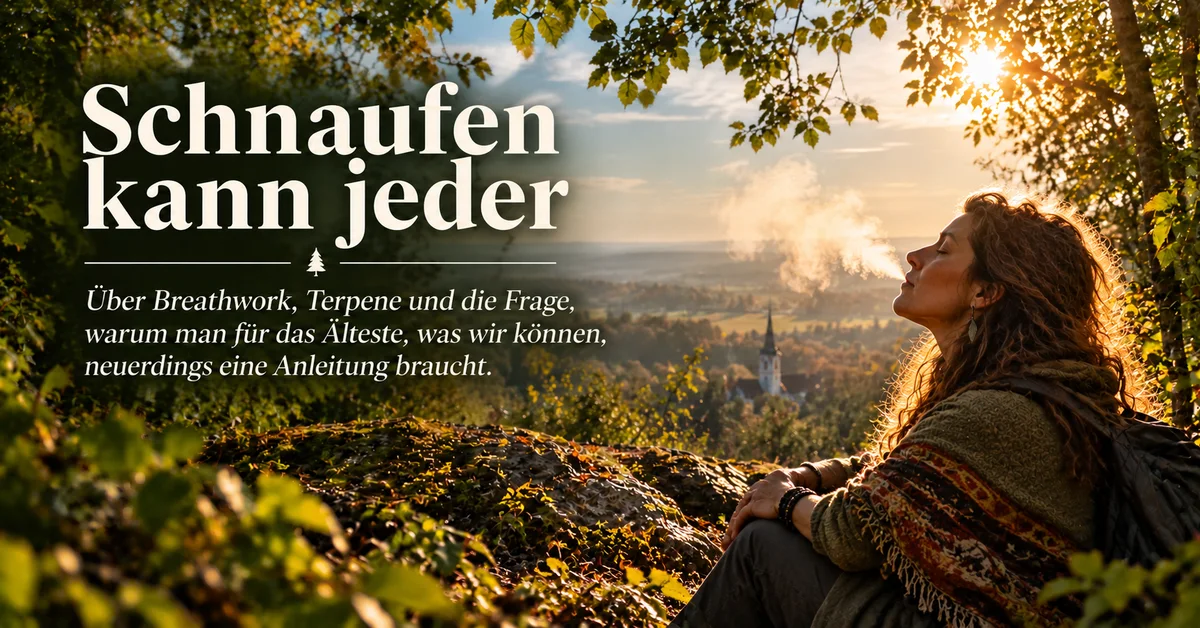
Anyone can breathe
On breathwork, terpenes and the question of why the oldest thing we can do suddenly needs instructions.
Around twenty thousand times a day, I breathe in and out again. Without an app, without a course, without a certificate. In my line of work, you might call it a background process that has been running for sixty years without an update.
As long as it works, nobody pays attention to it. Then you go into the forest, and suddenly breathing has become a method. It is called breathwork. It is supposed to calm the nervous system, lower cortisol, strengthen the immune system and release emotional blockages. Ideally with a few terpenes added.
I looked into what is true about it. It is less than promised. And more interesting for that.
What we know
Slow breathing has been studied extensively. In 2022, a team led by Cologne sports scientist Sylvain Laborde pooled the results of 223 studies. When people breathe slowly and consciously, a measure of their heartbeat increases that indicates the calming part of the nervous system is involved. This applies during the exercise, immediately afterwards and after several weeks of practice.
A British study in 2023 examined how much of this is due to the technique. Four hundred people breathed for ten minutes every day for four weeks. One group breathed slowly with instructions, the other at a normal pace as a placebo. Both groups felt better afterwards, and equally so.
Apparently, simply sitting down and breathing for ten minutes each day helped. No matter how.
For forests, there is a 2019 review. In almost all the studies included, levels of the stress hormone cortisol were lower after time in a forest than in the comparison group. In the short term, the authors emphasise.
The most delightful detail is in the small print. Cortisol was already lower in the forest groups before they had even set off. The researchers suspect an anticipated placebo effect.
Looking forward to the forest has an effect before you even enter it.
So perhaps all you need to do is plan to go to the forest often enough.
What we do not know
“Lasting” appears in none of these papers. Measurements were taken shortly afterwards, and the authors of the forest review themselves call for more data.
“Strengthens the immune system” is too big a claim as well. Some studies found changes in certain immune cells after time in a forest. How much that matters in everyday life and how long it lasts remain open questions.
Then there are the terpenes. The resinous smell in the Steckerleswald comes from terpenes. The claim that they strengthen our defences is based mainly on Japanese experiments. In one, twelve men slept for three nights in a city hotel where cypress oil was vaporised. Afterwards, certain immune cells were more active than before. Twelve men, one hotel, a before-and-after comparison: that is a beginning, not proof. The forest still smells good.
I found no study for emotional blockages. Nor an explanation of what a blockage is.
And the green lung? The tree breathes too. At night, it uses oxygen just as I do. I accept the image of giving and taking between a person and a tree as an image. As biology, it limps.
Indications are not promises.
Belly or chest
People often say there are two ways to breathe. Shallow breathing into the chest, which causes stress, and deep breathing into the belly, which takes it away. There is something to that. When you are rushed, your breaths are short and high in your chest. When you settle down, you breathe more slowly, and your belly moves with it. Anyone can observe this in themselves.
But the explanation is usually not quite right. Deep breathing hardly gives you more oxygen; in healthy people, the blood is already almost fully saturated with it. What changes is the pace. And whether shallow breathing causes stress or stress causes shallow breathing is not as clear-cut as advice books would like it to be.
That is why I would not talk about right and wrong breathing. The body breathes shallowly when it thinks there is danger. That is not a mistake; it is doing its job. All you can do is show it that there is no danger right now. For example, by going into the forest and slowing down for a while.
For forty years, up to ten
I have been doing this for forty years and on some days I do not make it to four before my tax return comes to mind.
Breath has a quality that hardly anything else in the body has. It runs by itself, yet I can intervene. The heart will not take instructions; the hand does nothing on its own.
Breath is where doing and allowing meet.
That is precisely why what bothers me about some breathwork promises is less the science than the tone. Breathe correctly. Breathe better. Activate the diaphragm. Allowing becomes doing again, and breathing becomes an achievement.
Nowadays, you can even breathe incorrectly. That takes some doing.
What the forest adds
Perhaps it is not primarily the terpenes at all. There is simply less going on in the forest. No screen, no message, nobody who needs something right now. In everyday life, breath gets lost. Walking up the Schmausenbuck, you hear it again.
When I accompany people into the forest, I therefore do not ask anyone to practise anything at first. We stop and notice that we are breathing. Anyone who wants more can breathe slowly for a while, about six breaths a minute. That is the pace studied in many trials. Whether it has to be exactly that pace is uncertain after the placebo study. If you feel dizzy, stop. Then the background process speaks up, and it is right.
What I do not promise is that any of this heals anything. What I often witness is someone noticing for the first time that day that they have brought a body with them.
Anyone can breathe. Noticing that you are breathing is the practice.
To finish, a song that says the same thing in a few minutes. “Breathe” by Télépopmusik, sung by Angela McCluskey in a voice that sounds as though it has already been through a few things. It is a quiet piece about emotional exhaustion and inner struggles. It offers no solution. The chorus advises nothing more than breathing. And it reminds us that tomorrow is another day. I hear that as an opportunity: you are allowed to keep trying. Counting is the same. If you lose track at four, you start again at one.
Télépopmusik – Breathe
By playing the video, you consent to a connection being established with YouTube. Personal data may be transferred to YouTube. No YouTube content is loaded before you consent.
And for anyone who likes things on a grander scale: “Inhale, Exhale, Remember To Breath” by Barac. Electronic music that takes its time. The label accompanies it with the story of a lunar rover rolling abandoned across the dead moon, driven by a purpose it does not understand.
The text compares us to this vehicle. We too move through life, often unsure where we are heading. The difference is breathing. It is the light in the darkness: a quiet prayer that proves we are alive and awake. Those who can hear their own breath, the text suggests, are living.
That is a lot of outer space for a single breath. I like it anyway. A machine that has travelled further than I have cannot do one thing: notice that it is there.
Barac – Inhale, Exhale, Remember To Breath
By playing the video, you consent to a connection being established with YouTube. Personal data may be transferred to YouTube. No YouTube content is loaded before you consent.
Sources
Laborde, S. et al. (2022): Effects of voluntary slow breathing on heart rate and heart rate variability. Neuroscience and Biobehavioral Reviews 138, 104711. DOI 10.1016/j.neubiorev.2022.104711
Fincham, G. W., Strauss, C., Cavanagh, K. (2023): Effect of coherent breathing on mental health and wellbeing: a randomised placebo-controlled trial. Scientific Reports 13. DOI 10.1038/s41598-023-49279-8
Li, Q. et al. (2009): Effect of phytoncide from trees on human natural killer cell function. International Journal of Immunopathology and Pharmacology 22(4), 951–959.
Antonelli, M., Barbieri, G., Donelli, D. (2019): Effects of forest bathing (shinrin-yoku) on levels of cortisol as a stress biomarker. International Journal of Biometeorology 63(8), 1117–1134. DOI 10.1007/s00484-019-01717-x
Would you like to experience the forest yourself?
If an article made you curious, feel free to write to me. Together we will find a suitable date.
Get in touch